
Kim Vercoulen
Recruitment Consultant
As recruiters, we are regularly approached by candidates who need help with their career planning. Some people know from an early age exactly what they want to become when they are older, while others need more time exploring their interests, skills, personality and values to decide which path to take.
This process can be complicated – where do you start? Thankfully, there are great tools available to help you make a strategic plan to reach your career goals. One of them is the SWOT analysis, a marketing tool that can also be projected on the labour market. In this article, I will discuss how you can use this tool to “find your bliss.”
A SWOT analysis is a strategic planning tool that can also be applied to career planning. After you have identified your career goals, this tool can help you:
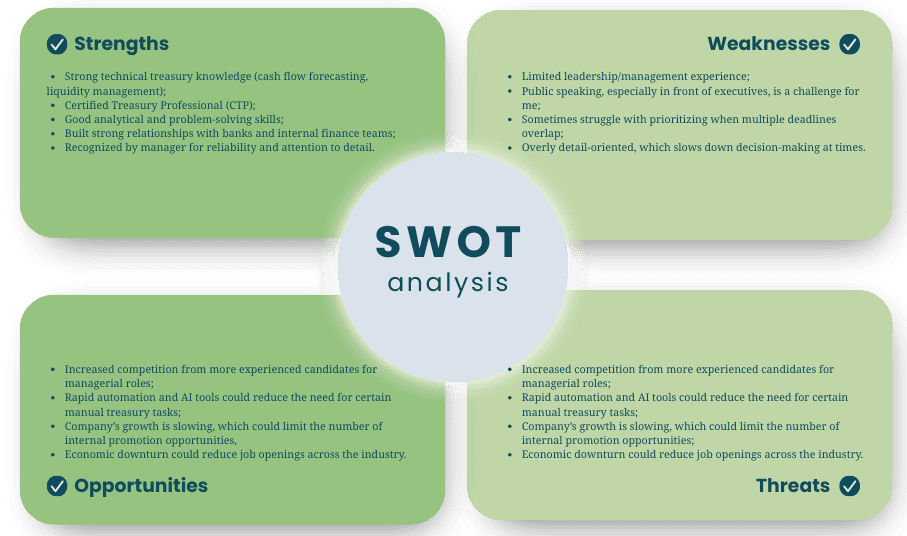
Your strengths are internal positive aspects that you control and that make you stand out in your field. Ask yourself:
Weaknesses are internal negative aspects that you control and can improve (or avoid in your next career step). Examining weaknesses can be uncomfortable, but to make a successful SWOT analysis, it’s vital to be as objective as possible. Sometimes others notice things you might be blind to – asking colleagues for feedback can help. Consider:
Opportunities are positive external conditions you do not control but can take advantage of. Ask yourself:
Threats are negative external conditions that you cannot control but may be able to mitigate. Reflect on:
Once you have answered these questions and written them down, the analysis will give you a realistic view of your situation. You will see:
👉 What strengths you can capitalise on
👉 What weaknesses you need to improve or avoid
👉 Which opportunities align with your strengths
👉 Which threats you should avoid or mitigate
A SWOT analysis is only the beginning of career planning. After completing it, ask yourself:
What direction do I want to take?
What steps are needed to get from where I am now to where I want to be?
Tools that can help:
Gap analysis – to develop a practical action plan.
Personal marketing plan – to position yourself effectively in the job market.
I hope this will give you some guidance in your career planning. By using a SWOT analysis, you can approach your next career move with clarity and strategy.

As recruiters, we are regularly approached by candidates who need help with their career planning. Some people know from an early age exactly what they want to become when they are older

A Treasury Risk Manager was placed in Hamburg eight days after joining a search already handled by four agencies. Discover how the right network made the difference.

Why do treasury professionals stay with Dutch employers? Explore how transparency, autonomy, flexibility and development shape retention in the Netherlands.
Since the start of Treasurer Search in 2009, we keep track of the markets we are active in. Originally fully manual, gradually automating further. It will not come as a surprise we nowadays include AI in these processes. In this article we want to share what analysis of the treasury labour market shows. In gathering data we of course aim at full coverage but do know that is not feasible. At executive level, for example, recruitment processes often are not visiible to us. At entry level, we see in various countries that people enter the labour market in different ways.
Treasury hiring across the Netherlands, Germany and Belgium in the first half of 2026 produced aproximatelly 1,300 vacancies in our database. Read together rather than separately, those three markets tell a story that no single country report can: the same function, recruited in three structurally different ways.
Germany hires across the full depth of the ladder and builds capability internally. The Netherlands hires for technical execution and has been reshaped by employers who were not competing for treasury talent a decade ago. Belgium hires almost exclusively for experience and has effectively stopped developing its own.
Looking at volume, seniority, sector demand and geographic concentration reveals where each market is strong, where it is stretched, and what that means for anyone hiring or moving across borders.
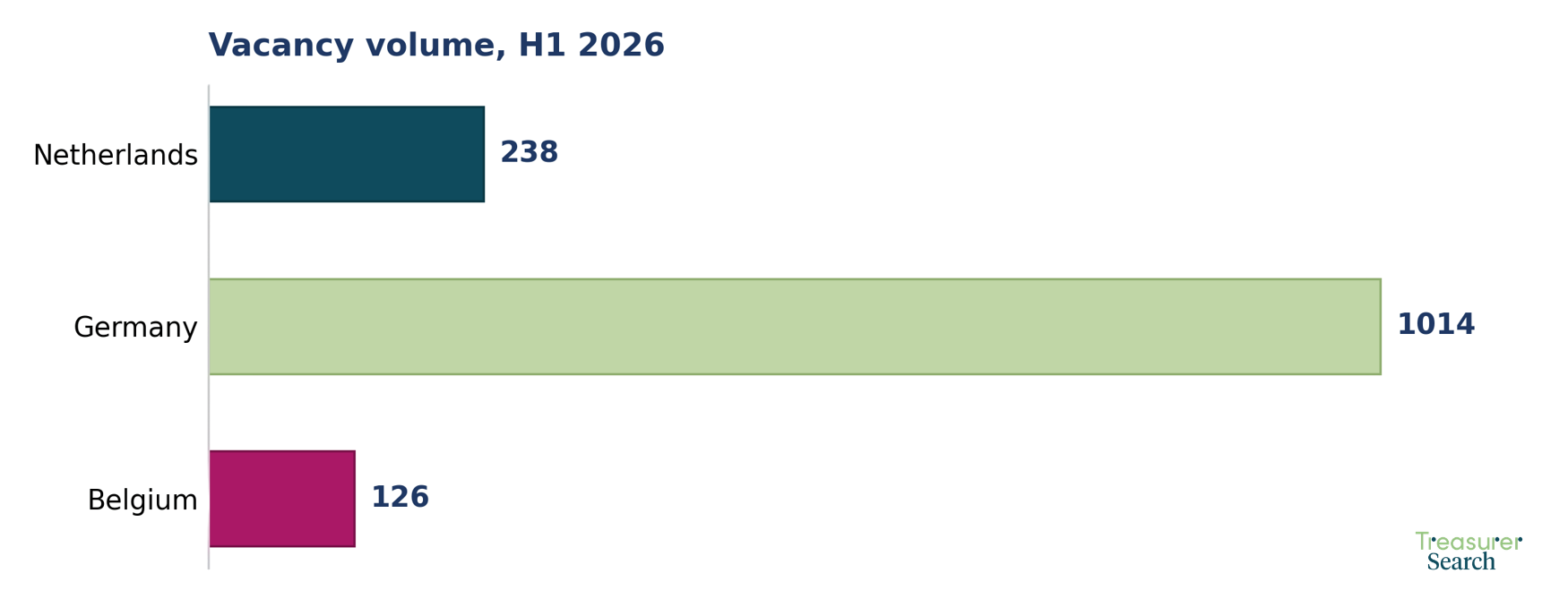
Germany produced 1,014 vacancies against 238 in the Netherlands and 126 in Belgium. Much of that reflects the relative size of each economy. What the sector split adds is that manufacturing accounts for 18.9% of German vacancies against 8.4% in the Netherlands, pointing to an industrial base that carries treasury headcount of its own.
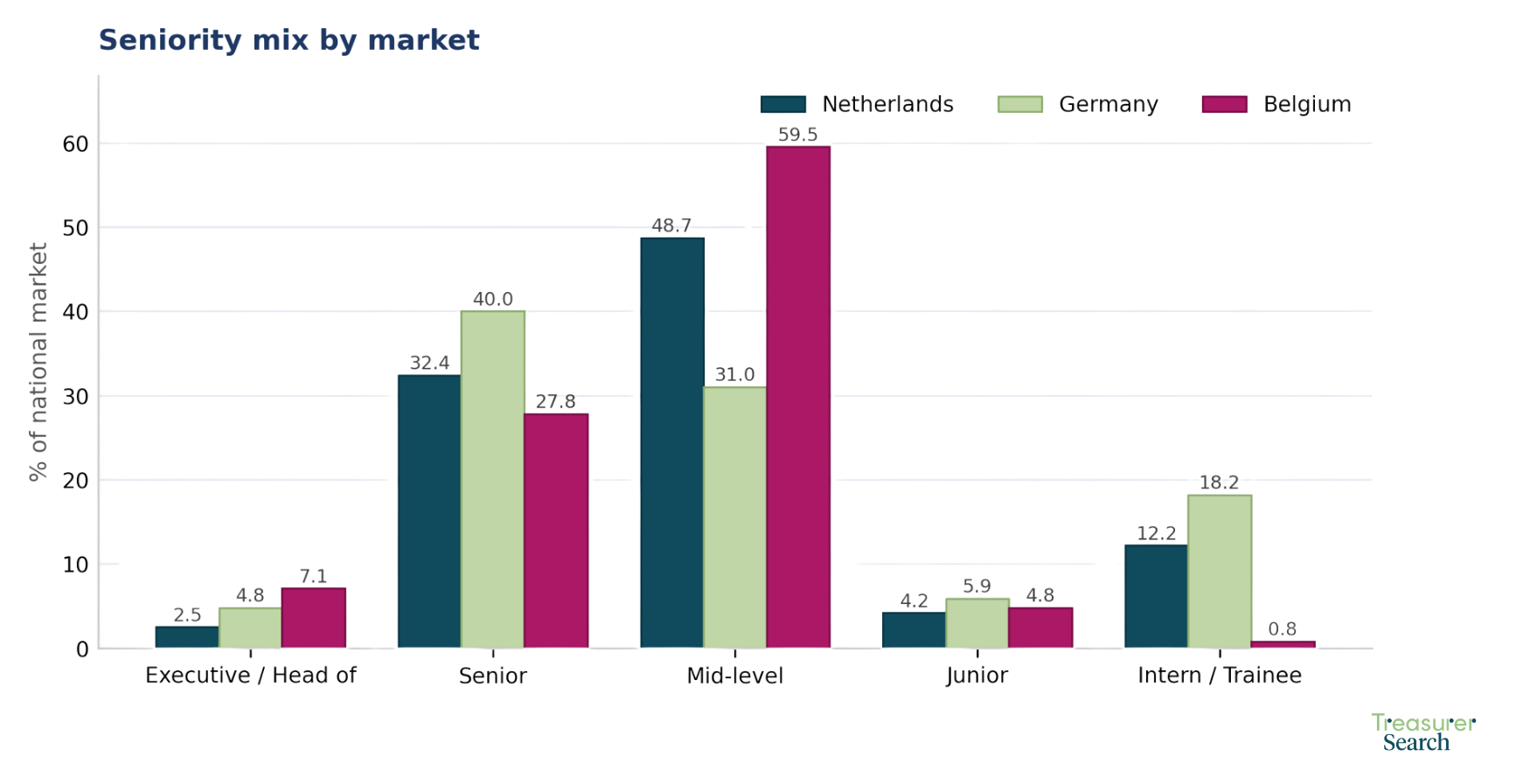
The clearest divergence is at the bottom of the ladder. Germany placed 18.2% of its vacancies in internships and traineeships, with a further 5.9% in junior roles, meaning close to a quarter of all German treasury hiring sits at entry level. The Netherlands recorded 12.2% in internships and 4.2% junior. Belgium recorded a single treasury internship across the six months and six junior vacancies, together under 6% of its market.
That difference is institutional rather than cyclical. The Werkstudent, Praktikum and Ausbildung system gives German employers a structured route to build treasury capability internally. Dutch employers use internships to similar effect, though at lower volume. Belgian employers do neither at any scale, and are consequently buying almost every treasury professional they need from a pool nobody is replenishing.
At the top, the pattern reverses. Executive and Head of Treasury roles accounted for 7.1% of the Belgian market against 4.8% in Germany and 2.5% in the Netherlands. On absolute numbers this reads differently: 49 leadership vacancies in Germany against nine in Belgium and six in the Netherlands. Germany is the only market where treasury leadership search runs at a steady frequency; elsewhere it is an occasional event.
The middle of the ladder is where the comparison gets slippery. Belgium put 59.5% of its vacancies at mid-level against Germany’s 31%, and Germany carried 40% in the senior band against Belgium’s 27.8%. Job titles drive these bands, and German employers apply the Manager label more readily than Belgian ones, so read the gap as indicative rather than exact.
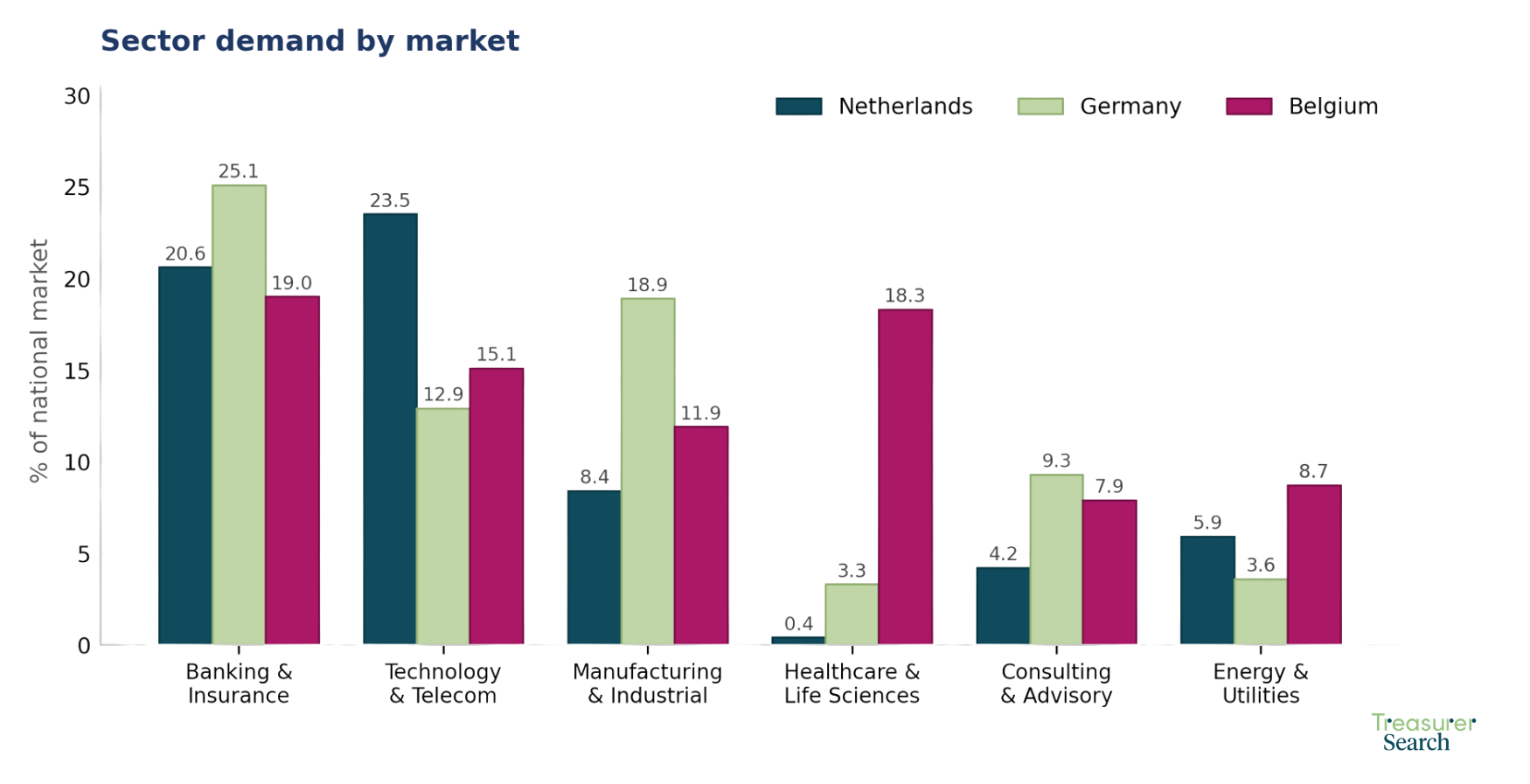
Banking, insurance and asset management remains the largest single sector in Germany at 25.1%, and shares the lead in Belgium at 18.4%. In the Netherlands it has been overtaken. Technology, software and telecom led the Dutch market with 23.5% against banking’s 20.6%, with Booking.com, Adyen and ASML now competing directly with ABN AMRO, ING and Rabobank for the same profiles. That reordering has consequences for pay benchmarks that reach well beyond the technology sector itself.
Manufacturing and industrials accounted for 18.9% of German vacancies, the second largest sector there and roughly double its share in the Netherlands. Siemens, BASF, Salzgitter and the wider Mittelstand run treasury as a standalone function rather than an appendage of group finance.
Belgium’s distinguishing sector is healthcare and life sciences at 18.4%, level with banking. Johnson & Johnson in Beerse, UCB, IBA and Eurofins give the country a life-sciences treasury base with no equivalent concentration in either neighbouring market.
Consulting and advisory tracks the size of the underlying market: 9.3% in Germany, 8% in Belgium and 4.2% in the Netherlands. Where that share is low, treasury transformation work is more likely being resourced internally.
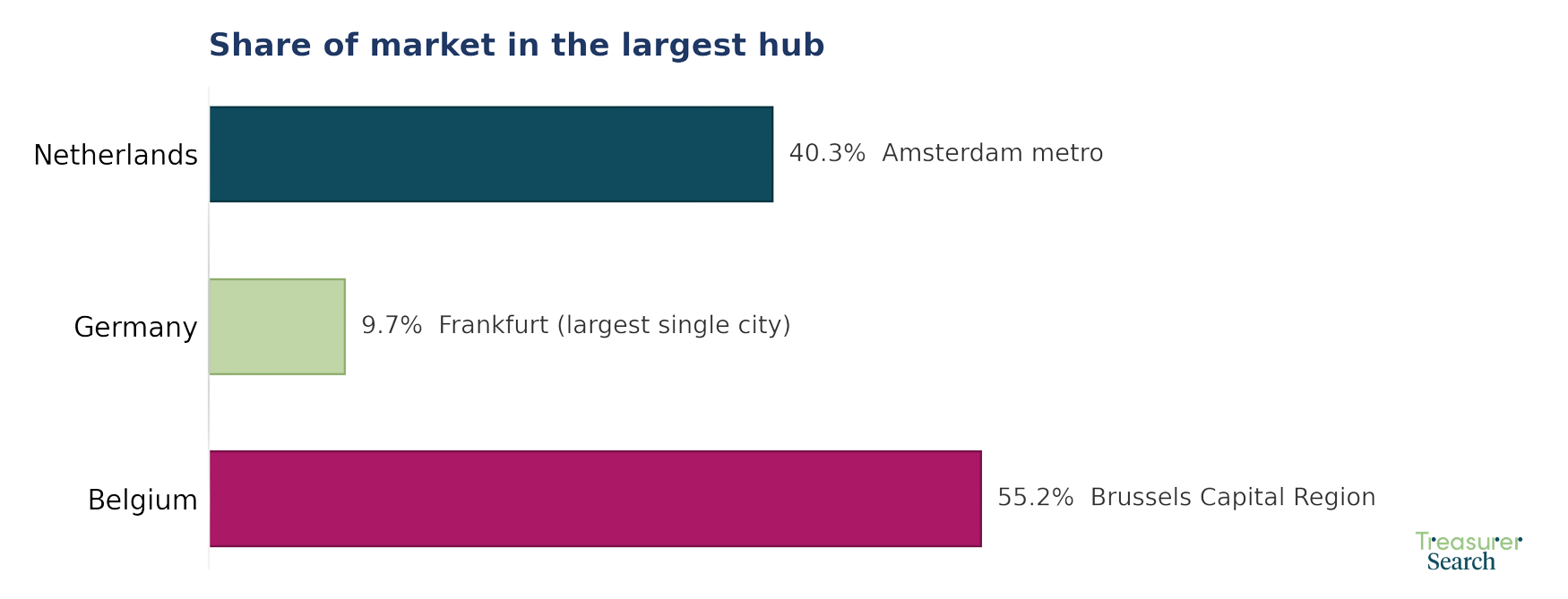
Geographic concentration varies more sharply than any other measure. Belgium is the most centralised market: 55.2% of vacancies sit in the Brussels region including Zaventem, Diegem and Machelen, with Flanders adding 28.8% and Wallonia registering a single vacancy across six months. Treasury in Belgium is a Brussels and Flanders function, and any search built on a different assumption will exhaust its candidate pool quickly.
The Netherlands is concentrated but not closed. The Amsterdam metro area accounted for 40.3%, with Rotterdam and The Hague at 19.3% and Utrecht at 12.6%. Hybrid arrangements out of Amsterdam draw candidates from both without requiring relocation, which effectively widens the pool beyond what the headline figure suggests.
Germany has no dominant hub at all. Frankfurt led on 9.7%, followed by Hamburg at 8.6%, Munich at 8.4%, Duesseldorf at 8% and Berlin at 7.1%. No single city passes 10%, and the top fifteen cities together account for only 55.6% of vacancies, with the balance spread across a further 244 locations. Recruiting in Germany means engaging with several regional markets plus a long industrial tail rather than one national one.
Taken together, the H1 2026 data describes three markets that are converging on the same profile of treasury professional while approaching the supply problem in opposite ways. Germany builds, the Netherlands partly builds and partly buys, and Belgium buys. Where volume is smallest, competition for experienced practitioners is sharpest, because there is no pipeline behind them.
For employers, the practical implications differ by market. In Belgium, the absence of any junior intake means competition for mid-level talent will not ease on its own, and interim mandates are already filling part of the leadership gap. In the Netherlands, salary benchmarks are increasingly set outside financial services. In Germany, the assumption that Frankfurt is the answer is worth testing, since Duesseldorf, Munich and Hamburg often offer deeper local supply and materially less competition.
For professionals, the cross-border picture is encouraging at mid and senior level, where all three markets are active, and considerably harder at the top. Between them, these markets produced approximately 60 Executive and Head of Treasury vacancies in six months. Depth, systems fluency and cross-sector exposure remain the qualities that separate candidates in every one of them.

126 Belgian treasury vacancies analysed. Mid-level takes 59.5%, entry-level hiring has nearly vanished, 55% of roles sit in Brussels.

238 Dutch treasury vacancies analysed. Technology now outhires banking at 23.5%, mid-level roles dominate, and only six Head of Treasury roles reached market.

1014 Treasury-Stellen analysiert. Keine Stadt hält 10% des Marktes, Banken führen mit 25,1%, ein Viertel aller Stellen ist Einstiegsniveau.
Disclaimer about these numbers!
These figures reflect treasury and treasury-adjacent vacancies captured in our own database for 1 January to 30 June 2026, covering 1,377 roles across the three markets. They are an approximation, not an official labour-market statistic. Some postings are duplicated across job boards, some are never advertised publicly, and industry classification is based on the hiring company. We are not the law. But we do know this market, and the shape of the data holds up.
If you want to discuss more on this topic, reach out to our specialists:



The Belgian treasury market in the first half of 2026 reflects a function that continues to be built almost entirely through experienced hires. Across sectors, organisations are looking for treasury professionals who can operate independently from day one, and they are showing very little sign of developing that capability internally.
By looking at seniority levels, industry distribution and geographic concentration, a clear picture is painted of how treasury roles are positioned in Belgium today, and where demand is structurally strong or limited. The data below covers 126 vacancies and highlights not only who is hired, but also what kind of treasury function organisations are building.
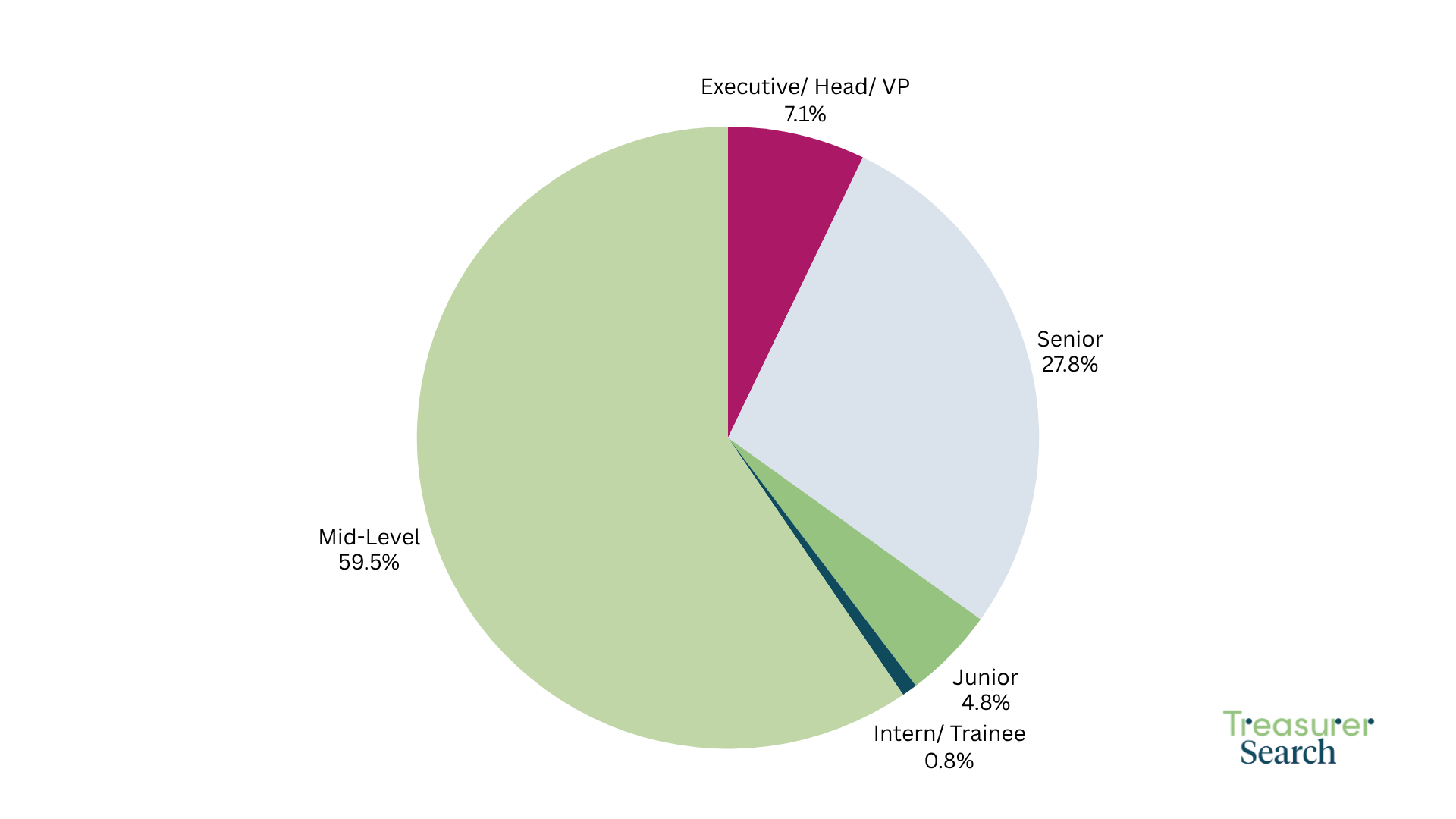
The Belgian market was heavily weighted toward experienced hands-on roles. Mid-level positions made up 59.5% of the market, with senior and managerial roles at 27.8%. Together this accounts for 87% of treasury hiring, leaving very little activity at either end of the ladder.
Executive and Head of Treasury roles accounted for 7.1%, nine vacancies in total, four of which were interim or freelance mandates. This points to turnover within a small leadership pool, with a meaningful share of demand met through flexible arrangements rather than permanent headcount.
Entry-level hiring was close to absent. Junior roles represented 4.8% and internships or traineeships only 0.8%. Belgium continues to be a difficult market for early-career treasury profiles, and the near-total absence of a pipeline tightens the mid-level pool that every employer is already competing in.
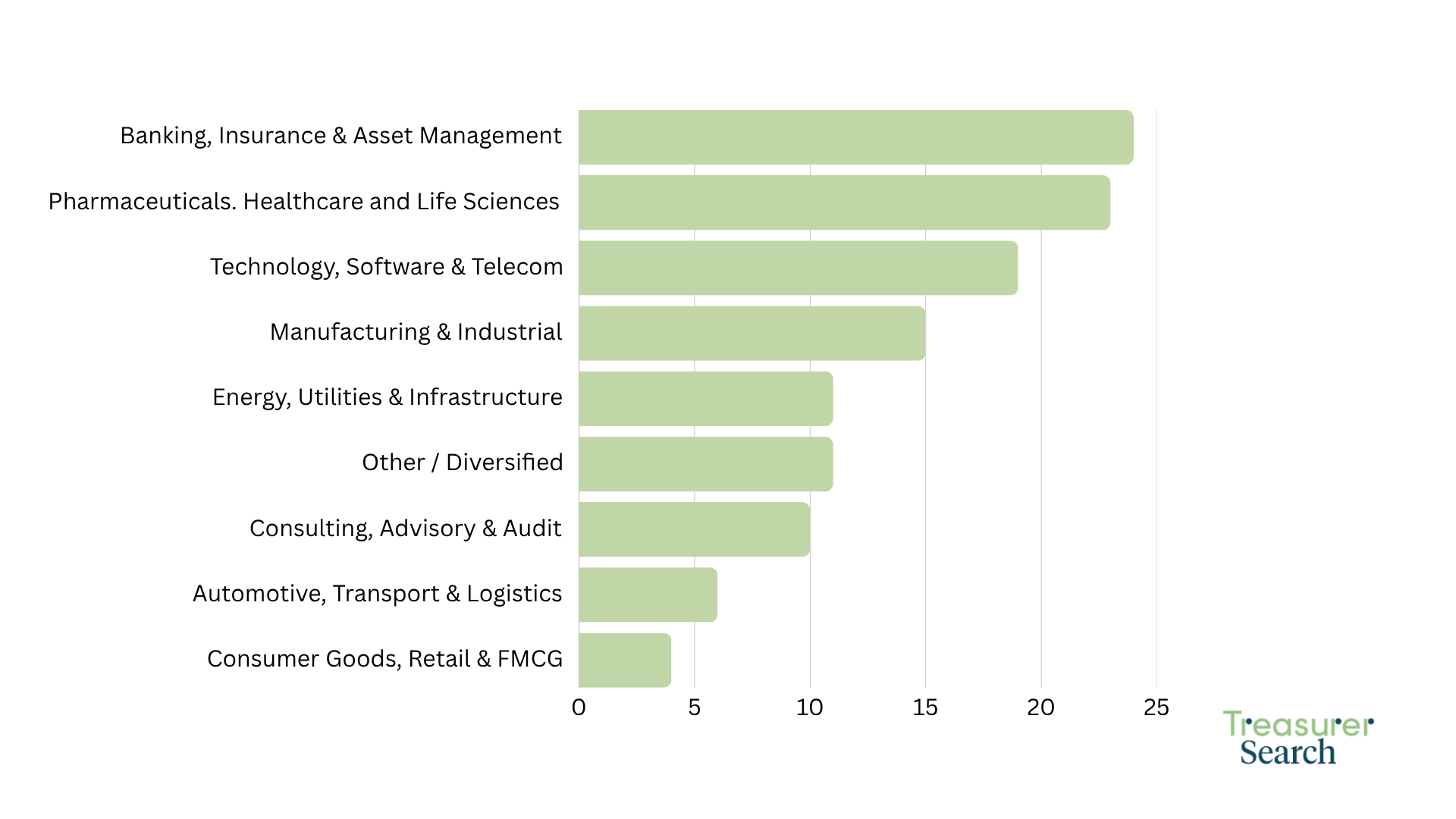
From an industry perspective, demand was well diversified across three sectors of comparable weight. Banking, insurance and asset management led with 19%, narrowly ahead of healthcare and life sciences at 18.3%. That healthcare figure is driven by Johnson & Johnson in Beerse, UCB, IBA and Eurofins, and gives the country an unusually strong life-sciences treasury base.
Technology and telecom followed at 15.1%, ahead of manufacturing and industrials at 11.9%, where Bekaert, Umicore, Atlas Copco and Daikin remain consistently active.
Infrastructure, energy and utilities accounted for 8.7%, including Fluxys and Equans, while consulting and advisory represented 7.9%, underlining sustained demand for treasury transformation and project expertise.

Geographically, the market remained highly centralised. Just under 55% of roles were based in the Brussels region, including key business hubs such as Zaventem, Diegem and Machelen. Flanders accounted for 28.6%, driven mainly by Antwerp, Ghent, Leuven and the Beerse pharmaceutical cluster.
Wallonia registered a single vacancy across the entire six months. Treasury in Belgium is a Brussels and Flanders function, and any search built on a different assumption will exhaust its candidate pool quickly. The remaining 15.9% reflects roles with national scope or less specific location data, often linked to hybrid or multi-site setups.
Taken together, the H1 2026 data paints a picture of a mature and highly selective treasury market. Demand is concentrated at mid-level, leadership roles turn over within a small pool and a significant share arrive as interim mandates, and junior entry points remain structurally limited. Industry demand is diversified across financial services, life sciences and industry, while geography continues to favour Brussels as the dominant treasury hub.
For employers, this means competition for experienced treasury talent remains high, and with almost no early-career intake that competition will not ease on its own. For professionals, it reinforces the importance of depth, adaptability and cross-sector exposure. Belgium in H1 2026 is not a high-volume hiring market for treasury, but it is a market where expertise, leadership and strategic capability are clearly valued.
If you want to discuss more on this topic, reach out to our Belgium specialist: Haia Aaraj.
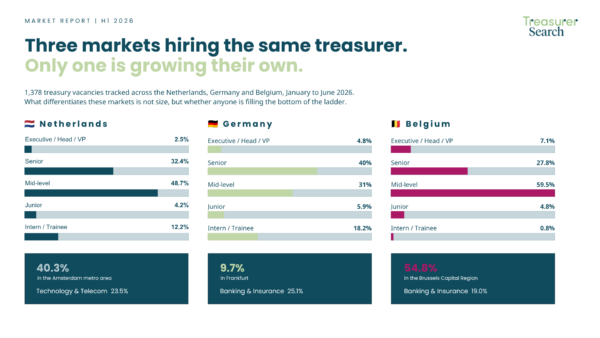
1,378 treasury vacancies across three markets. Germany hires at every level, the Netherlands buys technical depth, and Belgium buys experience.
238 Dutch treasury vacancies analysed. Technology now outhires banking at 23.5%, mid-level roles dominate, and only six Head of Treasury roles reached market.
1014 Treasury-Stellen analysiert. Keine Stadt hält 10% des Marktes, Banken führen mit 25,1%, ein Viertel aller Stellen ist Einstiegsniveau.
These figures reflect treasury and treasury-adjacent vacancies captured in our own database for 1 January to 30 June 2026. They are an approximation, not an official labour-market statistic. Some postings are duplicated across job boards, some are never advertised publicly, and industry classification is based on the hiring company rather than the role itself. We are not the law. But we do know this market, and the shape of the data holds up.
The Dutch treasury market in the first half of 2026 reflects a function built around depth of execution rather than breadth of leadership. Across sectors, organisations are hiring treasury professionals who can run cash, liquidity and risk processes independently, and increasingly they are hiring them into technology companies rather than banks.
By looking at seniority levels, industry distribution and geographic concentration, a clear picture is painted of how treasury roles are positioned in the Netherlands today, and where demand is structurally strong or limited. The data below covers 238 vacancies and highlights not only who is being hired, but also what kind of treasury function organisations are building.
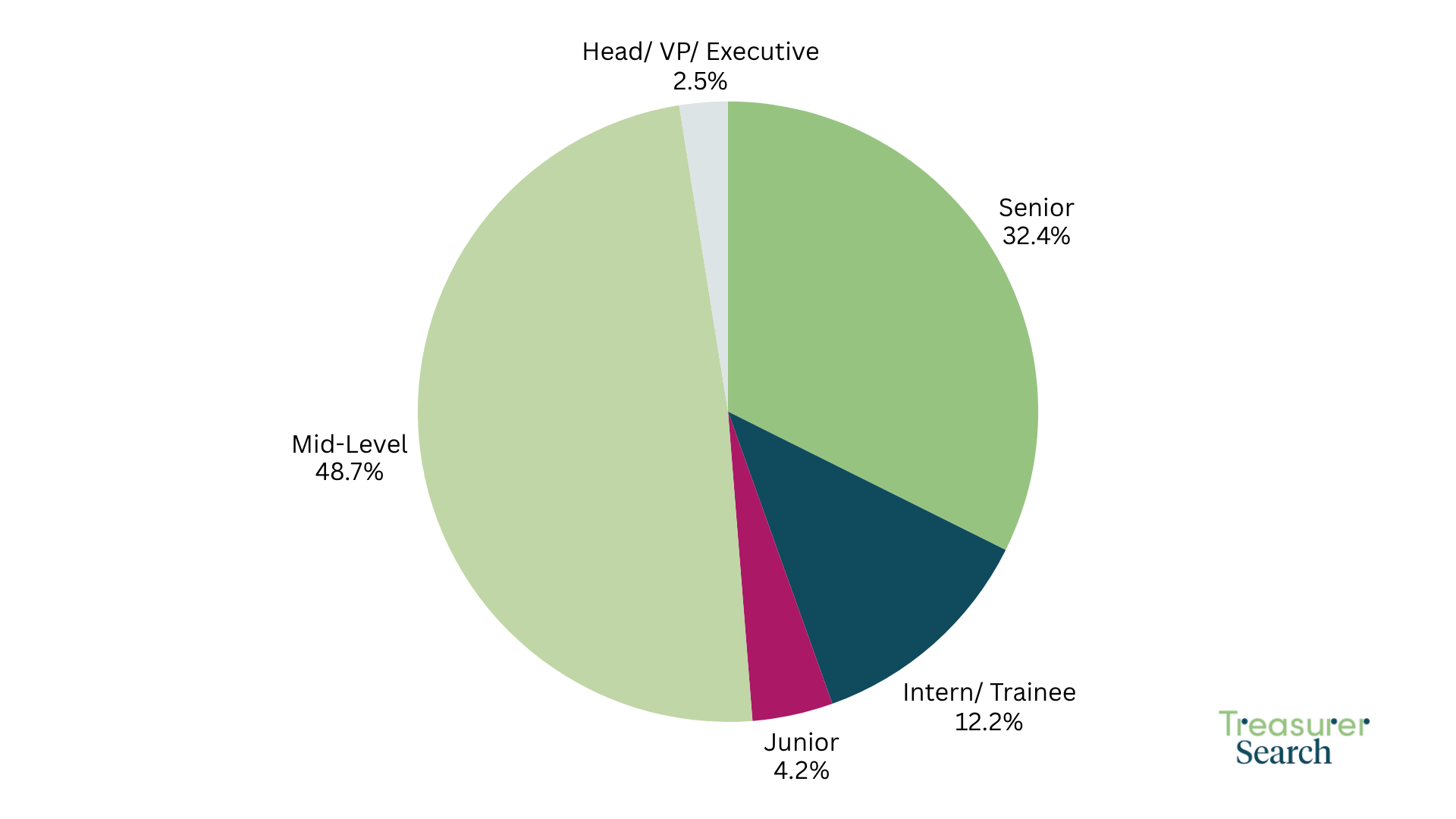
The Dutch market was clearly weighted toward the professional core. Mid-level positions made up 48.7% of the market, with senior and managerial roles at 32.4%. Together, this means over 80% of treasury hiring targeted professionals with established hands-on experience.
Executive and Head of Treasury roles accounted for just 2.5%. On that volume, leadership openings are occasional events rather than a steady stream, pointing to a settled top layer with slow turnover rather than active transformation.
(Good to keep in mind that, at executive level, recruitment processes may not be always visible to us. )
Junior roles remained limited at 4.2%, but internships and traineeships added a further 12.2%. The Netherlands builds its early-career pipeline through structured internships rather than junior-titled permanent positions, and the two figures need reading together to see the real entry point.
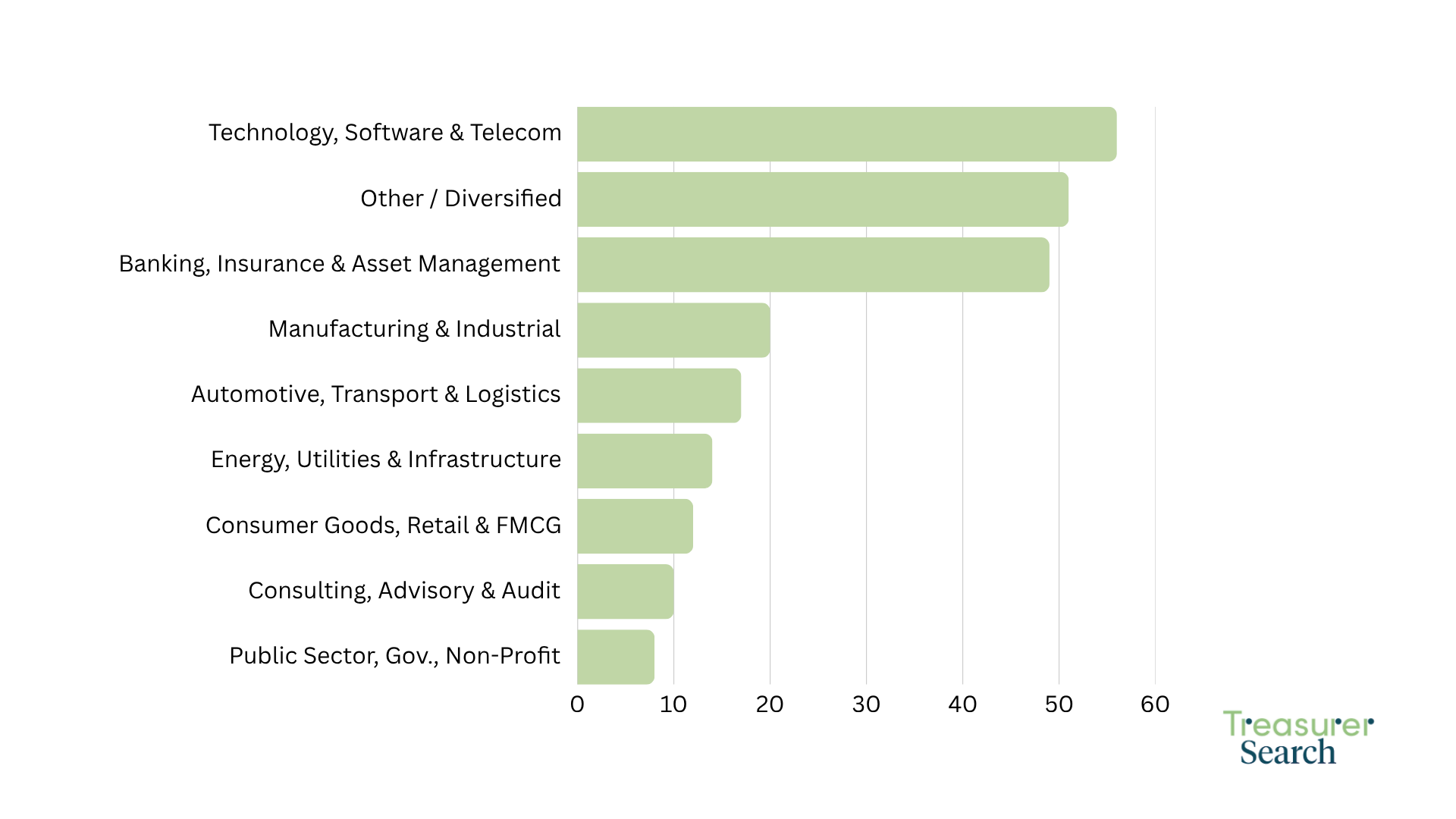
From an industry perspective, demand has shifted away from the sector that traditionally defined it. Technology, software and telecom led with 23.5%, narrowly ahead of banking, insurance and asset management at 20.6%.
Booking.com, Adyen and ASML are now competing directly with ABN AMRO, ING and Rabobank for the same treasury profiles.
Manufacturing and industrials followed at 8.4%, with transport and logistics at 7.1% and energy and utilities at 5.9%, reflecting financing complexity and working capital needs in capital-intensive sectors.
Consulting and advisory represented 4.2%, a modest share suggesting most treasury transformation work is being resourced internally rather than bought in. A further 21.4% sits with companies whose profile did not map cleanly to a sector, mostly smaller B.V.s and scale-ups where treasury forms part of a broader finance mandate.
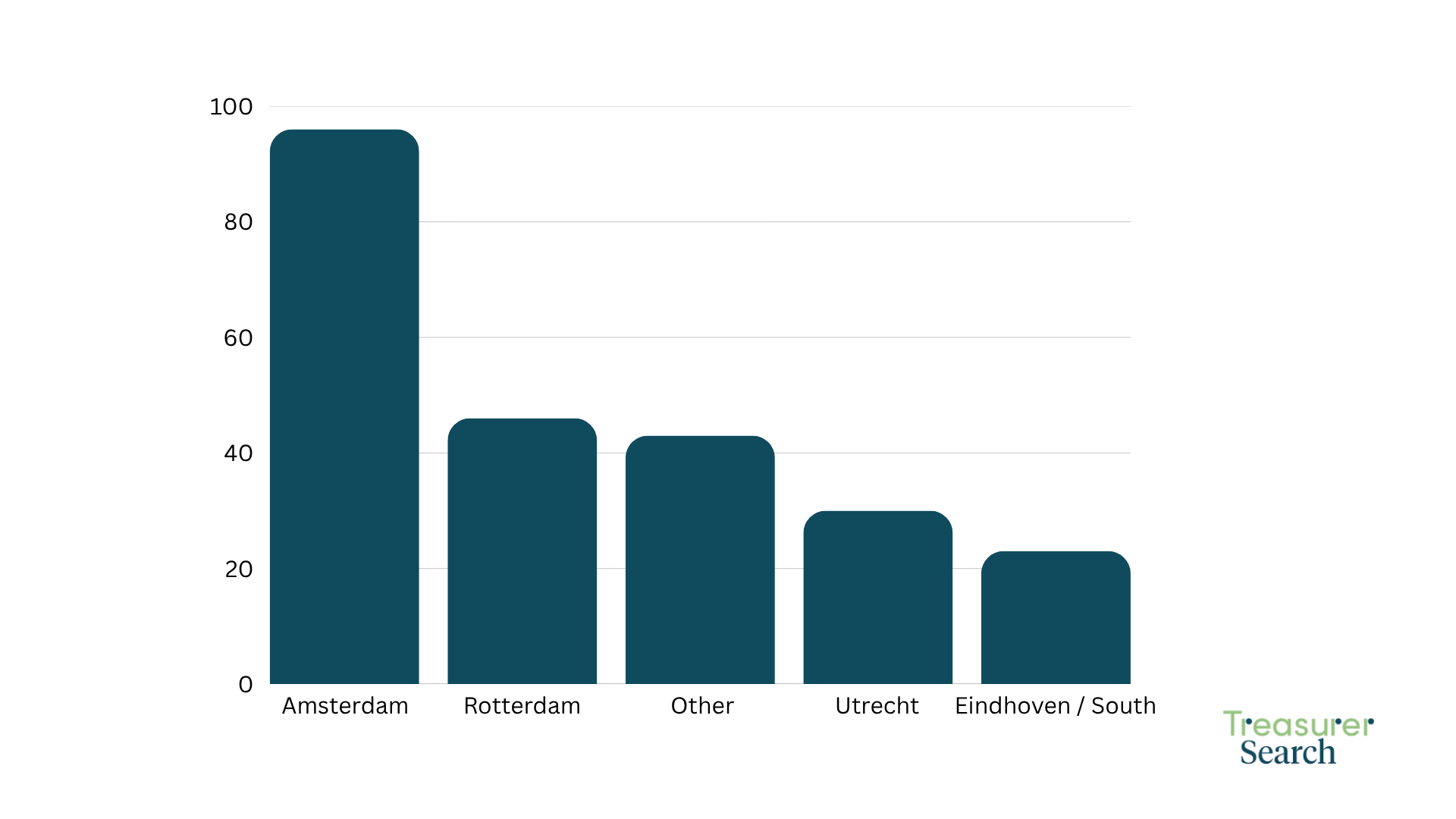
Geographically, the market remained concentrated but not closed. Just over 40% of roles were based in the Amsterdam area, including Amstelveen, Hoofddorp and Schiphol. Rotterdam and The Hague together accounted for 19.3%, with the Utrecht region at 12.6%.
Eindhoven and the southern provinces represented 9.7%, driven by ASML and the Brainport industrial cluster. The remaining 18.1% reflects roles with national scope or less specific location data, often linked to hybrid or remote setups.
Taken together, the H1 2026 data paints a picture of a technically demanding treasury market. Demand is concentrated at mid and senior levels, leadership openings are rare, and entry points run through internships rather than junior roles. Industry demand has tilted decisively toward technology, while geography continues to favour Amsterdam as the dominant hub.
For employers, this means competition for experienced treasury talent now extends well beyond financial services, and salary benchmarks set by technology employers are reshaping the mid-level market. For professionals, it reinforces the value of systems fluency alongside treasury depth. The Netherlands in H1 2026 is a strong market for experienced practitioners, but a patient one for those targeting leadership.
If you want to discuss more on this topic, reach out to our Netherlands specialists: Pieter de Kiewit, Ron van Haeff, Kim Vercoulen, Haia Aaraj.
1,378 treasury vacancies across three markets. Germany hires at every level, the Netherlands buys technical depth, and Belgium buys experience.
126 Belgian treasury vacancies analysed. Mid-level takes 59.5%, entry-level hiring has nearly vanished, 55% of roles sit in Brussels.
1014 Treasury-Stellen analysiert. Keine Stadt hält 10% des Marktes, Banken führen mit 25,1%, ein Viertel aller Stellen ist Einstiegsniveau.
These figures reflect treasury and treasury-adjacent vacancies captured in our own database for 1 January to 30 June 2026. They are an approximation, not an official labour-market statistic. Some postings are duplicated across job boards, some are never advertised publicly, and industry classification is based on the hiring company rather than the role itself. We are not the law. But we do know this market, and the shape of the data holds up.
In treasury recruitment there is often a natural focus on active candidates. People who are visibly on the market, applying for roles, responding to messages, and open to conversations. They are easier to reach, easier to engage, and often quicker to move through a process.
But if you look closely at the treasury talent landscape, the most interesting candidates are rarely the active ones.
Active candidates are typically in transition. That can be for many good reasons, but it also means their current situation is not always stable or strategically strong. In a niche like treasury, where experience is built over years inside complex structures, that matters.
Passive candidates are a different story. They are usually embedded in strong corporate environments, managing real complexity, working closely with CFOs, and not actively looking for a move. They are not browsing job boards and they do not respond to generic outreach. But they are often the ones with the deepest and most relevant experience.
This is where the real tension in treasury hiring sits. The best candidates are not necessarily the ones who are available. They are the ones who need to be identified, understood, and approached with precision.
Reaching passive treasury talent is not about volume. It is about relevance. They do not respond to job descriptions, they respond to context. Why this role, why now, and what is actually different compared to what they are doing today.
That means the approach has to be more consultative than transactional. Less “are you interested in a new role” and more “this is what we see in the market, and this is how your profile fits into a very specific opportunity”.
Active candidates still play a role in any process, especially for speed and pipeline building. But if the goal is to hire the strongest possible treasury professional, passive candidates consistently bring more depth, more stability, and more relevant experience.
The real skill in treasury recruitment is not choosing between active or passive candidates. It is knowing when to use each, and how to engage the passive market in a way that makes them actually listen.
As recruiters, we are regularly approached by candidates who need help with their career planning. Some people know from an early age exactly what they want to become when they are older
A Treasury Risk Manager was placed in Hamburg eight days after joining a search already handled by four agencies. Discover how the right network made the difference.
Why do treasury professionals stay with Dutch employers? Explore how transparency, autonomy, flexibility and development shape retention in the Netherlands.
With Thierry Aartsen stepping in as Minister of Social Affairs and Employment, a clear shift in policy toward freelancers is emerging.
The previous government spent years working on the VBAR legislation, intended to clarify the distinction between employees and self-employed workers. In practice, it created more uncertainty than clarity. Aartsen has already scrapped most of this proposal in his first weeks in office.
What remains is the “presumption of employment” for low-paid freelancers. This allows individuals with low hourly rates to go to court and claim employee status if they believe they are falsely classified as self-employed.
The real change, however, lies in the underlying approach. Previously, the system leaned toward: employee, unless proven otherwise. The new initiative flips this to: self-employed, unless proven otherwise. That shift in perspective is significant.
For many freelancers, the past few years have felt restrictive, with increased enforcement and growing hesitation among clients to hire independent professionals. This new direction signals more recognition of freelancing as a legitimate and valuable way of working.
The core assessment criteria remain largely the same and focus on two areas:
The proposed framework will also introduce more sector-specific distinctions, meaning that in some industries individuals are more likely to be classified as employees than in others.
There is also a clear sense of urgency. Part of the revised legislation, specifically the presumption of employment, is expected to be submitted to parliament before the summer. This is tied to a deadline of August 31, linked to eligibility for European recovery funds.
The broader goal is to restore stability in the labor market. Uncertainty in recent years has made many organizations reluctant to engage freelancers. Alongside legislative changes, the government is even considering a public campaign to reduce that hesitation.
My view is that this could mark an important step toward a more balanced labor market. Less ambiguity, more trust, and clearer rules for both freelancers and clients. The real impact will depend on how these plans are implemented in practice.
I am curious to hear what others are seeing in the market right now.
As recruiters, we are regularly approached by candidates who need help with their career planning. Some people know from an early age exactly what they want to become when they are older
A Treasury Risk Manager was placed in Hamburg eight days after joining a search already handled by four agencies. Discover how the right network made the difference.
Why do treasury professionals stay with Dutch employers? Explore how transparency, autonomy, flexibility and development shape retention in the Netherlands.
A question many candidates are quietly asking themselves. The short answer? January felt slow. By mid‑April, activity picked up fast, even approaching record levels.
But if you are considering your own next move, that information may not help you as much as you think. Because in reality, you only need one thing: one role that fits, one employer who says yes.
Aggregated market numbers are interesting, sometimes comforting, sometimes stressful, but rarely decisive for individual outcomes. It reminds me of doctors explaining population statistics to patients. Useful context, yes. But it doesn’t replace the conversation about your situation.
Treasury is a niche market. Very niche. There are solid macro studies out there, but their conclusions often don’t translate cleanly to a specialised treasury role, at a specific company, with a specific hiring manager.
Which brings it back to what actually helps: don’t let yourself be distracted by market noise.
Focus on:
If you need a role, the fundamentals don’t change, regardless of the headlines.
Good luck!
As recruiters, we are regularly approached by candidates who need help with their career planning. Some people know from an early age exactly what they want to become when they are older
A Treasury Risk Manager was placed in Hamburg eight days after joining a search already handled by four agencies. Discover how the right network made the difference.
Why do treasury professionals stay with Dutch employers? Explore how transparency, autonomy, flexibility and development shape retention in the Netherlands.
When discussing the treasury interim market in Europe, three neighbouring countries offer a fascinating contrast: the Netherlands, Germany, and Belgium. Despite their geographic proximity, the maturity, dynamics, and mindset surrounding interim treasury professionals differ significantly.
Understanding these differences is crucial, not only for hiring managers but also for treasury professionals navigating cross-border opportunities.
The Netherlands has firmly established itself as a mature interim market. Interim hiring is not viewed as an exception or a last resort, but as a fully accepted workforce strategy.
Dutch organisations typically prefer to work with one trusted supplier rather than engaging multiple agencies simultaneously. This model is built on partnership and confidence: clients rely on their chosen provider to deliver a curated selection of high-quality profiles.
Rather than creating noise, this approach creates efficiency.
Clients still retain choice, but without duplicated efforts, conflicting communication, or unnecessary market friction.
Another structural factor contributes to the Netherlands’ strong interim culture: lean treasury teams.
Compared to many other European countries, Dutch treasury departments are often relatively small. When a team member becomes unavailable, whether due to resignation, illness, parental leave, or project demands, the operational pressure on remaining colleagues increases rapidly.
In such environments, interim professionals are not a luxury.
They are a pragmatic solution.
Germany presents a different landscape.
Treasury teams are typically larger and more layered. As a result, immediate operational urgency tends to be less acute. Instead of reacting quickly to temporary gaps, German organisations more frequently engage interim professionals for specific projects or specialised initiatives.
These assignments, however, arise less frequently.
Another notable characteristic of the German market is its hiring approach. It is common for organisations to invite multiple agencies to search for candidates simultaneously, effectively sending everyone to “fish in the same pond.”
While this may appear competitive, it creates unintended consequences.
Only one agency will ultimately be compensated for its efforts. The others absorb the cost of unbillable time, research, and candidate engagement. Over time, this dynamic inevitably influences pricing structures. Margins rise. Ironically, the client later questions these higher margins, a familiar debate within many professional communities.
There is also a candidate-side impact. Interim professionals are often approached multiple times for the same assignment, generating confusion and fatigue rather than a positive hiring experience.
Efficiency, once again, becomes the hidden casualty.
Belgium represents yet another stage of market evolution.
The concept of treasury interim professionals is still less deeply embedded. When Belgian organisations consider temporary external expertise, they often turn first to the Big Four consulting firms rather than independent contractors or specialized interim professionals.
This preference has clear implications.
Consulting-driven solutions frequently come with significantly higher cost structures, while the flexibility and agility of independent interim professionals remain underutilized.
This difference is visible in market activity: the pool of active treasury interim professionals in Belgium remains comparatively limited.
Simply put, the ecosystem is still developing.
Beyond structural and cultural factors, language requirements play a decisive role across all three markets.
Belgium strongly favours Belgian nationals or French-speaking professionals.
Germany typically requires fluency in German alongside English.
The Netherlands stands out for its flexibility: in many cases, English proficiency alone is sufficient.
This openness significantly broadens the available talent pool and reinforces the Netherlands’ position as the most dynamic treasury interim market in the region.
When combining market maturity, hiring dynamics, and accessibility, a natural ranking emerges:
The Netherlands: the most mature and fluid interim treasury market
Germany: structured, selective, and project-oriented
Belgium: still evolving and consultant-driven
For organisations, recognising these differences enables smarter workforce strategies. Interim hiring is not merely about filling gaps, it is about choosing the right model for operational continuity, expertise deployment, and cost efficiency.
For treasury professionals, market awareness shapes career decisions. Language capabilities, mobility, and expectations must align with local market realities.
One lesson stands out across all borders:
The interim market is not just about availability.
It is about mindset.
And in that respect, the Netherlands continues to set the pace.
As recruiters, we are regularly approached by candidates who need help with their career planning. Some people know from an early age exactly what they want to become when they are older
A Treasury Risk Manager was placed in Hamburg eight days after joining a search already handled by four agencies. Discover how the right network made the difference.
Why do treasury professionals stay with Dutch employers? Explore how transparency, autonomy, flexibility and development shape retention in the Netherlands.
My colleague recently started a new assignment in the Netherlands, and three weeks later the signed contract was already on the table. This speed is almost unimaginable for the German market.
But why does it move so fast there and so slowly here?
My assumption is that the difference in notice periods plays a major role. In the Netherlands, one month is the standard. This changes the entire pace, because companies know that if they make a quick decision, they can also hire and onboard someone quickly. As a result, everyone involved automatically moves faster. Candidates can start earlier, clients make decisions more quickly, and the overall momentum stays consistently high. Also because if the other companies move faster, they get the candidates.
In Germany, a three month notice period is standard, in Treasury sometimes even until the end of the quarter or up to six months. So when a company decides to fill a new position, it is often expected that a new employee can start in three months at the earliest. I suspect this immediately takes pressure out of the process. Decisions drag on, and the urgency and necessity to move the process quickly simply isn’t perceived, because a placement will happen no sooner than three months anyway.
One thing, however, should be clear to every company: SPEED LEADS TO DECISIONS!
Candidates often choose the position where the company was simply faster and had the offer on the table first. Fast processes force decisions to be made earlier, and declining a good offer that doesn’t come back, often leads candidates to choose the first offer!
It shouldn’t be too much to ask to decide within 48 hours of receiving an application whether an interview is wanted, and to then schedule it for the following week or even the same week. Just like it was possible for my colleague in three weeks to finish the whole process.
Is that simply not achievable in Germany?
Just from the perspective of work hours saved if a process takes 3 weeks instead of 3 months, it should be a no brainer for every company in my opinion. Plus, the access to the candidates that are choosing the faster offer, should at least make companies rethink how they want their recruitment departments to function.
As recruiters, we are regularly approached by candidates who need help with their career planning. Some people know from an early age exactly what they want to become when they are older
A Treasury Risk Manager was placed in Hamburg eight days after joining a search already handled by four agencies. Discover how the right network made the difference.
Why do treasury professionals stay with Dutch employers? Explore how transparency, autonomy, flexibility and development shape retention in the Netherlands.
A major shift may finally bring clarity to the Dutch freelance market.
Last Friday, the Dutch cabinet decided to scrap most of the proposed VBAR legislation, which had been in development for several years to clarify the difference between self-employed professionals and employees. The original proposal faced significant criticism from freelancers, clients, and a large part of parliament.
What remains is primarily the income protection component, which is actually a positive step. The hourly threshold has been increased from €33 to €38. Under the new proposal, freelancers earning below €38 per hour will be able to go to court to claim employee status. Importantly, the burden of proof will then lie with the client, who must demonstrate that the professional is genuinely self-employed.
In my view, this change makes the core objective of the legislation much clearer: protecting vulnerable workers from exploitation, while leaving genuine entrepreneurship largely untouched.
The amendment has already been submitted to the House of Representatives. If approved, the expectation is that the new law could come into effect as early as the beginning of next year. This would finally bring more clarity about when someone should be considered self-employed and when they should not.
In the meantime, the current DBA framework remains in place. However, reality has shown that the situation is less dramatic than many initially feared. So far, there are no known court cases involving the Dutch Tax Authority related to fines or reclassification of freelancers. That uncertainty had been one of the main concerns for HR and Legal departments of large organizations when hiring freelancers after January 1st, 2025.
So far, there have been no court cases initiated by or against the Dutch Tax Authority regarding the enforcement of the DBA framework. However, industry reports indicate that a small number of tax assessments have been issued, mainly in the construction and infrastructure sectors. These cases reflect the ongoing monitoring by the authorities but do not suggest widespread issues for freelancers or companies.
Hopefully, this development will help restore calm and confidence in the flexible labor market, while we move toward a clearer and more balanced legal framework for freelancers in the Netherlands.
As recruiters, we are regularly approached by candidates who need help with their career planning. Some people know from an early age exactly what they want to become when they are older
A Treasury Risk Manager was placed in Hamburg eight days after joining a search already handled by four agencies. Discover how the right network made the difference.
Why do treasury professionals stay with Dutch employers? Explore how transparency, autonomy, flexibility and development shape retention in the Netherlands.