Treasury Hiring Trends Across the Netherlands, Germany & Belgium in H1 2026
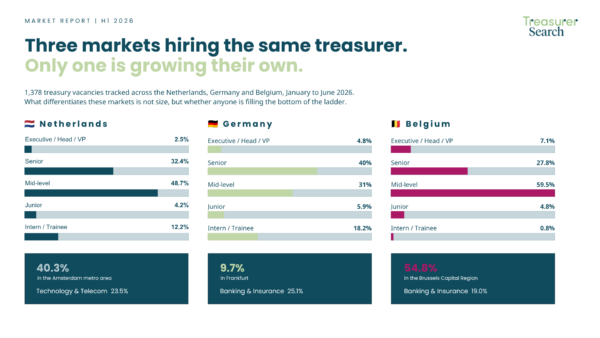
1,378 treasury vacancies across three markets. Germany hires at every level, the Netherlands buys technical depth, and Belgium buys experience.
The Dutch treasury market in the first half of 2026 reflects a function built around depth of execution rather than breadth of leadership. Across sectors, organisations are hiring treasury professionals who can run cash, liquidity and risk processes independently, and increasingly they are hiring them into technology companies rather than banks.
By looking at seniority levels, industry distribution and geographic concentration, a clear picture is painted of how treasury roles are positioned in the Netherlands today, and where demand is structurally strong or limited. The data below covers 238 vacancies and highlights not only who is being hired, but also what kind of treasury function organisations are building.
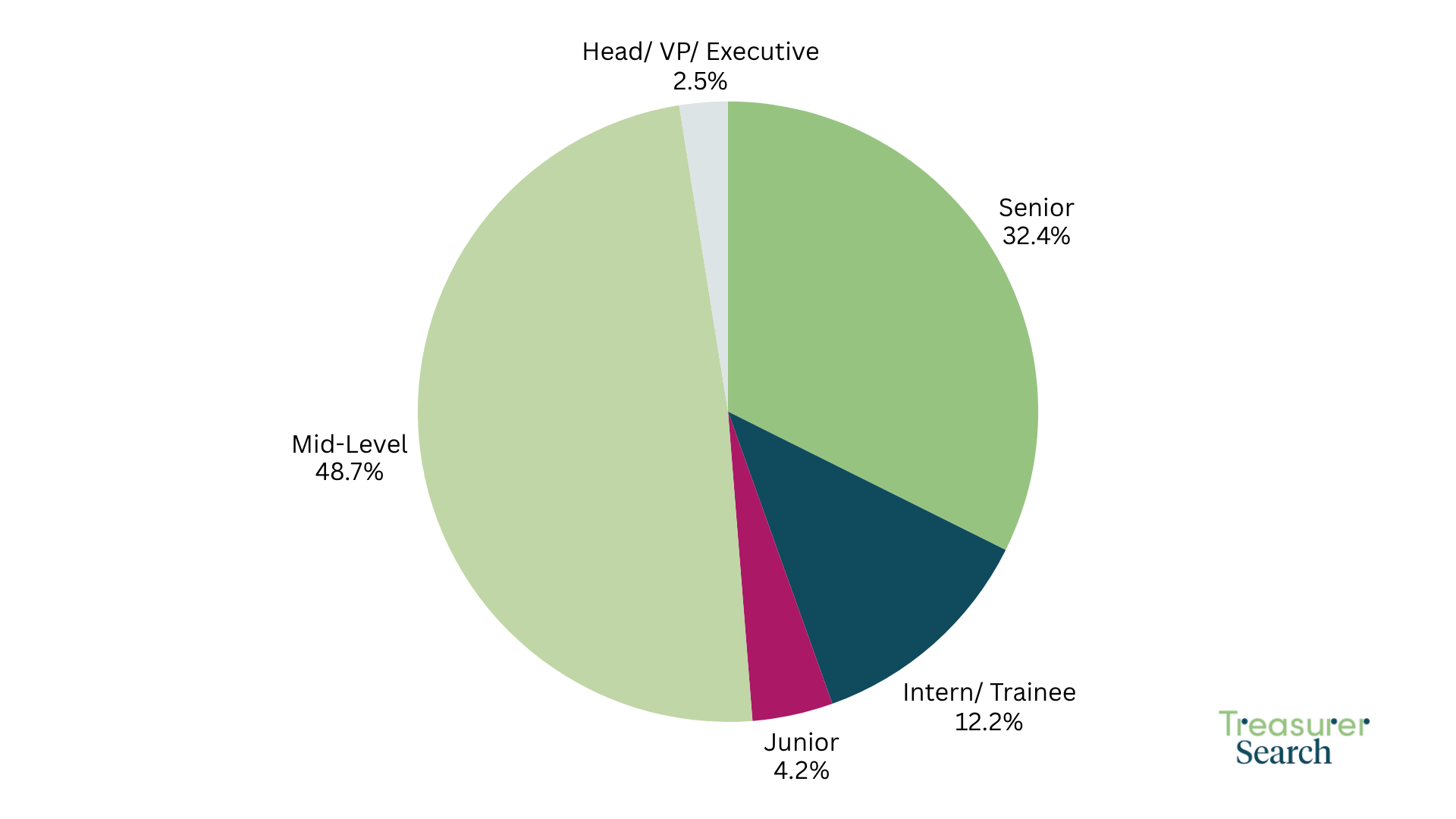
The Dutch market was clearly weighted toward the professional core. Mid-level positions made up 48.7% of the market, with senior and managerial roles at 32.4%. Together, this means over 80% of treasury hiring targeted professionals with established hands-on experience.
Executive and Head of Treasury roles accounted for just 2.5%. On that volume, leadership openings are occasional events rather than a steady stream, pointing to a settled top layer with slow turnover rather than active transformation.
(Good to keep in mind that, at executive level, recruitment processes may not be always visible to us. )
Junior roles remained limited at 4.2%, but internships and traineeships added a further 12.2%. The Netherlands builds its early-career pipeline through structured internships rather than junior-titled permanent positions, and the two figures need reading together to see the real entry point.
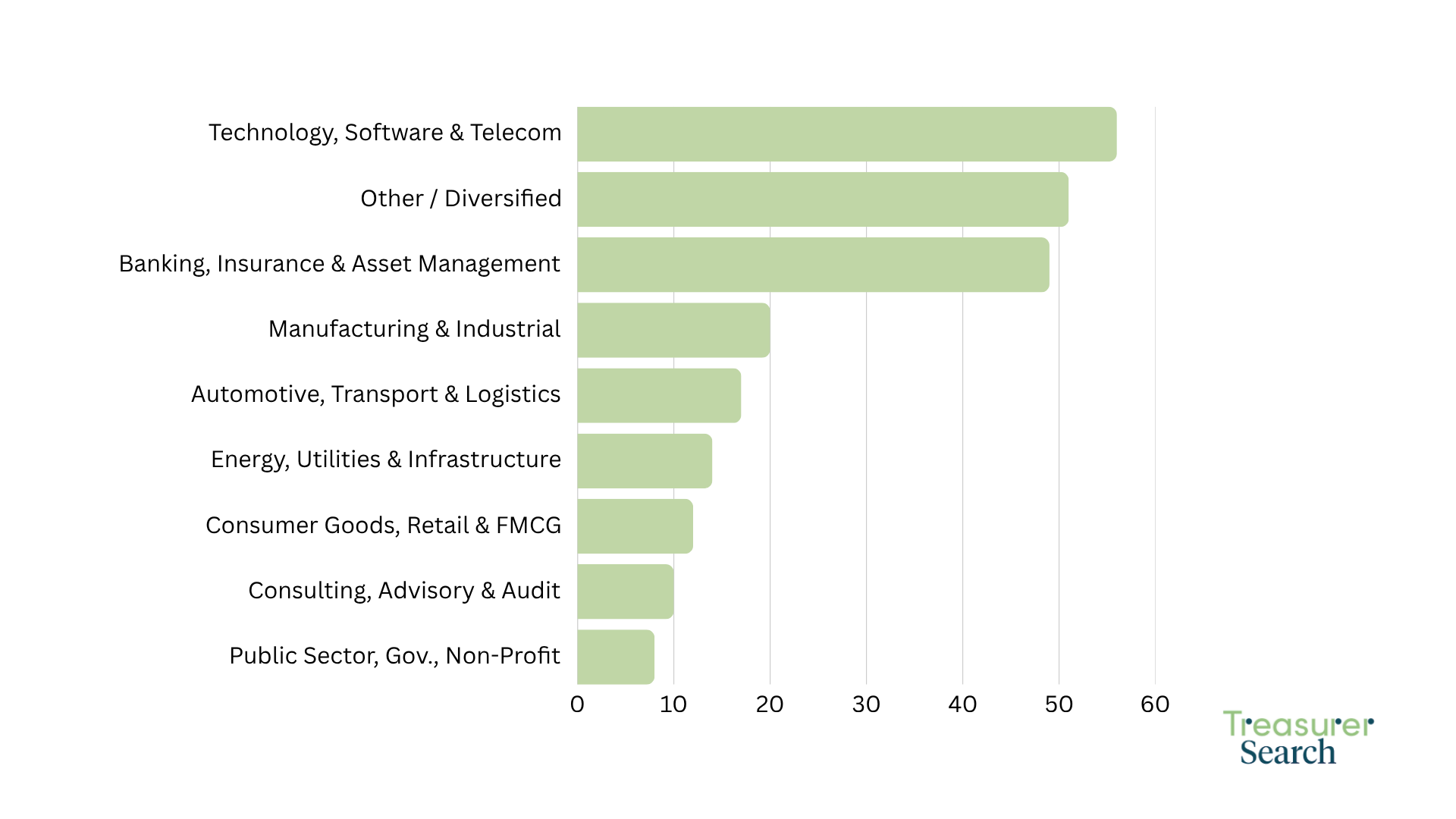
From an industry perspective, demand has shifted away from the sector that traditionally defined it. Technology, software and telecom led with 23.5%, narrowly ahead of banking, insurance and asset management at 20.6%.
Booking.com, Adyen and ASML are now competing directly with ABN AMRO, ING and Rabobank for the same treasury profiles.
Manufacturing and industrials followed at 8.4%, with transport and logistics at 7.1% and energy and utilities at 5.9%, reflecting financing complexity and working capital needs in capital-intensive sectors.
Consulting and advisory represented 4.2%, a modest share suggesting most treasury transformation work is being resourced internally rather than bought in. A further 21.4% sits with companies whose profile did not map cleanly to a sector, mostly smaller B.V.s and scale-ups where treasury forms part of a broader finance mandate.
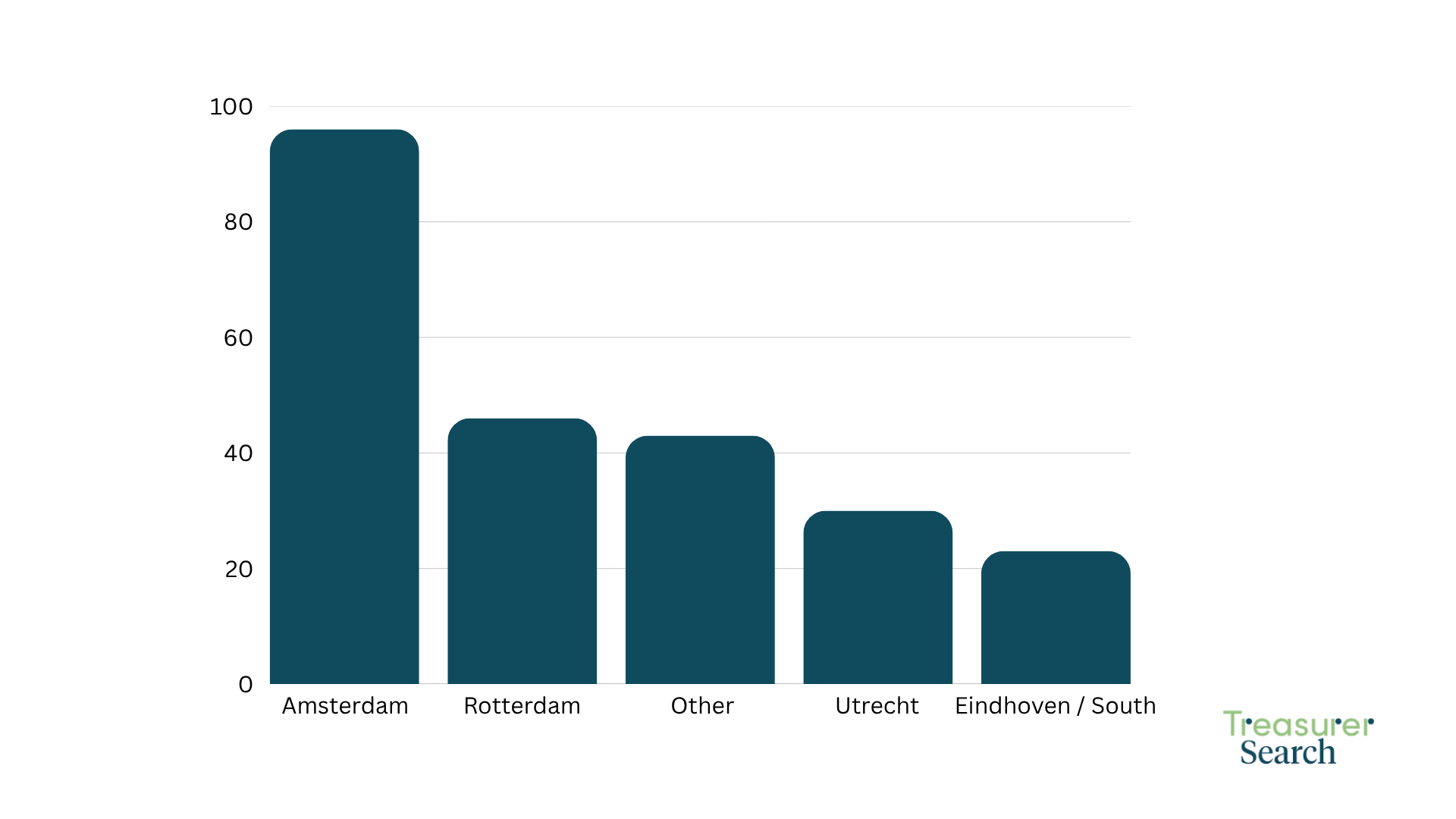
Geographically, the market remained concentrated but not closed. Just over 40% of roles were based in the Amsterdam area, including Amstelveen, Hoofddorp and Schiphol. Rotterdam and The Hague together accounted for 19.3%, with the Utrecht region at 12.6%.
Eindhoven and the southern provinces represented 9.7%, driven by ASML and the Brainport industrial cluster. The remaining 18.1% reflects roles with national scope or less specific location data, often linked to hybrid or remote setups.
Taken together, the H1 2026 data paints a picture of a technically demanding treasury market. Demand is concentrated at mid and senior levels, leadership openings are rare, and entry points run through internships rather than junior roles. Industry demand has tilted decisively toward technology, while geography continues to favour Amsterdam as the dominant hub.
For employers, this means competition for experienced treasury talent now extends well beyond financial services, and salary benchmarks set by technology employers are reshaping the mid-level market. For professionals, it reinforces the value of systems fluency alongside treasury depth. The Netherlands in H1 2026 is a strong market for experienced practitioners, but a patient one for those targeting leadership.
If you want to discuss more on this topic, reach out to our Netherlands specialists: Pieter de Kiewit, Ron van Haeff, Kim Vercoulen, Haia Aaraj.
1,378 treasury vacancies across three markets. Germany hires at every level, the Netherlands buys technical depth, and Belgium buys experience.

126 Belgian treasury vacancies analysed. Mid-level takes 59.5%, entry-level hiring has nearly vanished, 55% of roles sit in Brussels.

1014 Treasury-Stellen analysiert. Keine Stadt hält 10% des Marktes, Banken führen mit 25,1%, ein Viertel aller Stellen ist Einstiegsniveau.
These figures reflect treasury and treasury-adjacent vacancies captured in our own database for 1 January to 30 June 2026. They are an approximation, not an official labour-market statistic. Some postings are duplicated across job boards, some are never advertised publicly, and industry classification is based on the hiring company rather than the role itself. We are not the law. But we do know this market, and the shape of the data holds up.