
Treasury Labour Market Trends H1 – Belgium
126 Belgian treasury vacancies analysed. Mid-level takes 59.5%, entry-level hiring has nearly vanished, 55% of roles sit in Brussels.
Since the start of Treasurer Search in 2009, we keep track of the markets we are active in. Originally fully manual, gradually automating further. It will not come as a surprise we nowadays include AI in these processes. In this article we want to share what analysis of the treasury labour market shows. In gathering data we of course aim at full coverage but do know that is not feasible. At executive level, for example, recruitment processes often are not visiible to us. At entry level, we see in various countries that people enter the labour market in different ways.
Treasury hiring across the Netherlands, Germany and Belgium in the first half of 2026 produced aproximatelly 1,300 vacancies in our database. Read together rather than separately, those three markets tell a story that no single country report can: the same function, recruited in three structurally different ways.
Germany hires across the full depth of the ladder and builds capability internally. The Netherlands hires for technical execution and has been reshaped by employers who were not competing for treasury talent a decade ago. Belgium hires almost exclusively for experience and has effectively stopped developing its own.
Looking at volume, seniority, sector demand and geographic concentration reveals where each market is strong, where it is stretched, and what that means for anyone hiring or moving across borders.
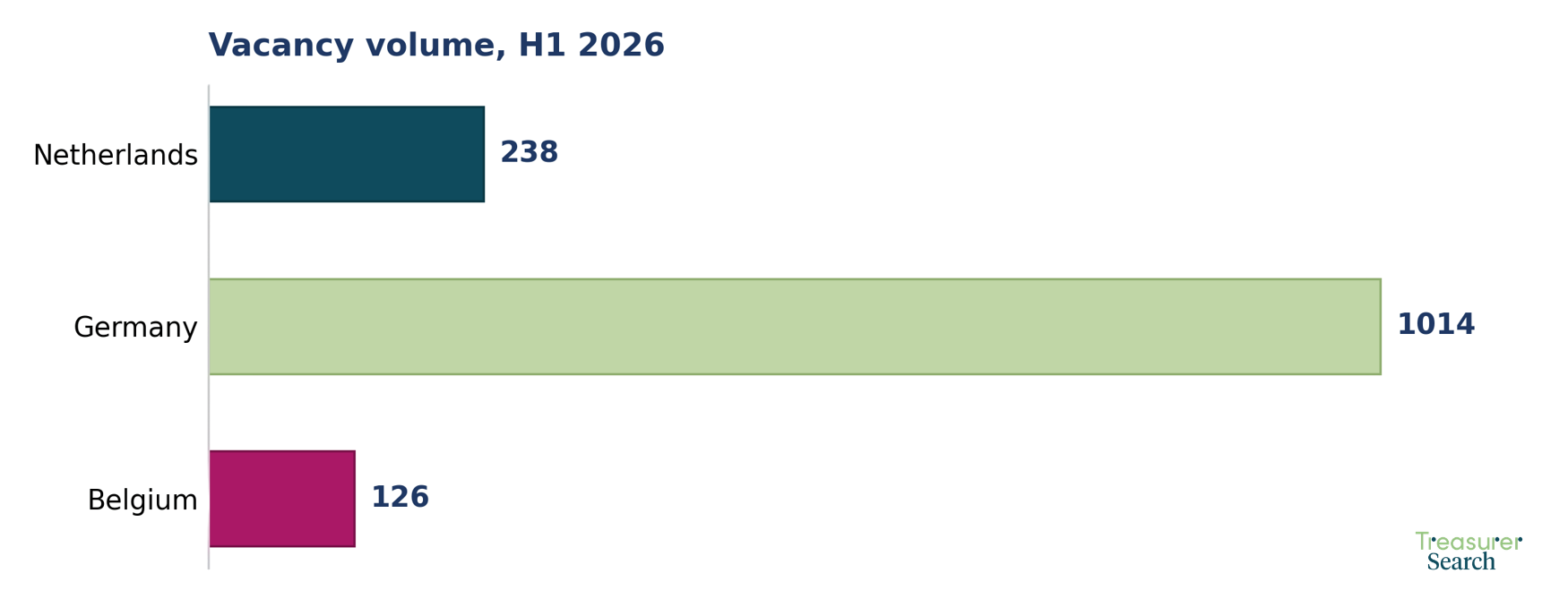
Germany produced 1,014 vacancies against 238 in the Netherlands and 126 in Belgium. Much of that reflects the relative size of each economy. What the sector split adds is that manufacturing accounts for 18.9% of German vacancies against 8.4% in the Netherlands, pointing to an industrial base that carries treasury headcount of its own.
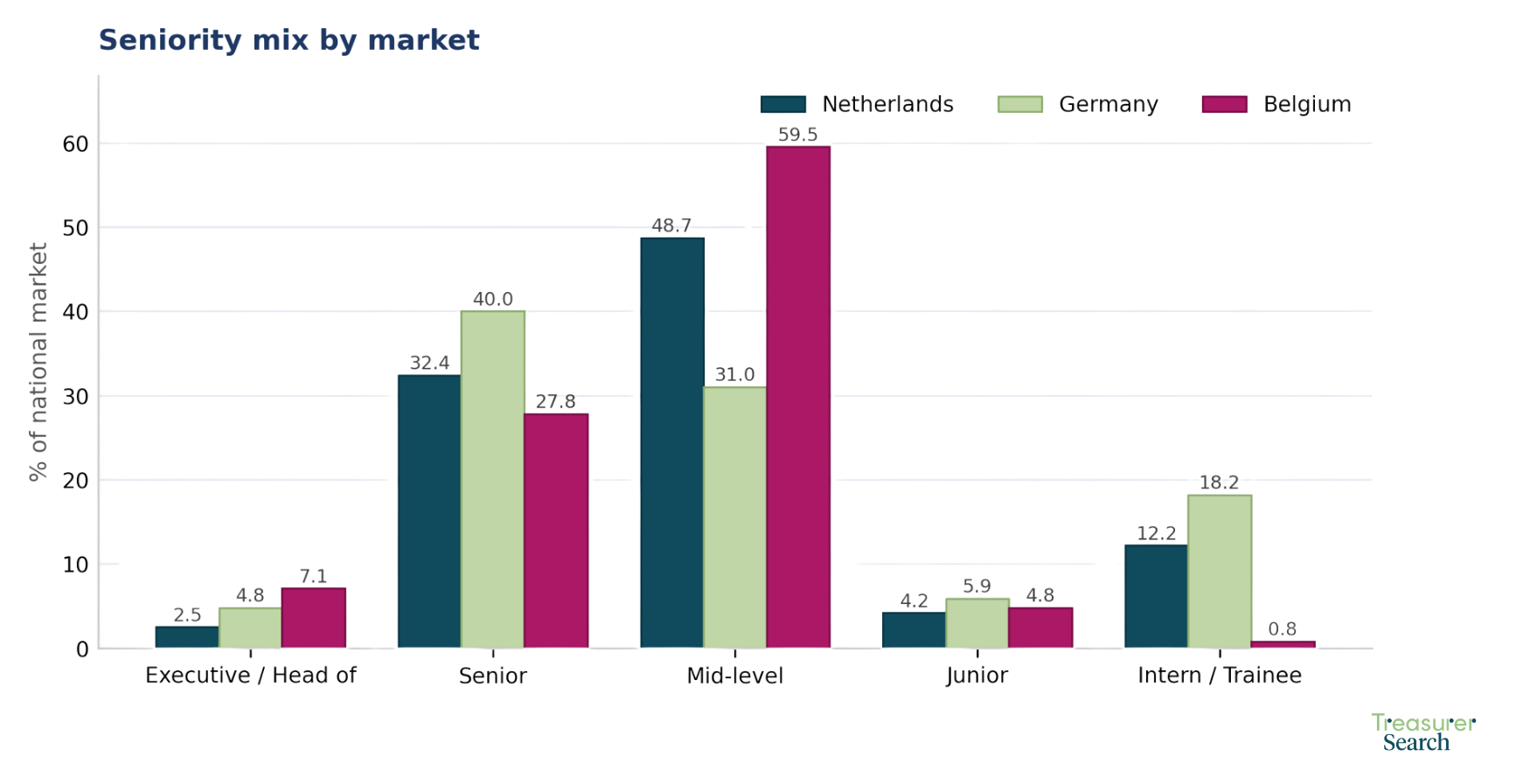
The clearest divergence is at the bottom of the ladder. Germany placed 18.2% of its vacancies in internships and traineeships, with a further 5.9% in junior roles, meaning close to a quarter of all German treasury hiring sits at entry level. The Netherlands recorded 12.2% in internships and 4.2% junior. Belgium recorded a single treasury internship across the six months and six junior vacancies, together under 6% of its market.
That difference is institutional rather than cyclical. The Werkstudent, Praktikum and Ausbildung system gives German employers a structured route to build treasury capability internally. Dutch employers use internships to similar effect, though at lower volume. Belgian employers do neither at any scale, and are consequently buying almost every treasury professional they need from a pool nobody is replenishing.
At the top, the pattern reverses. Executive and Head of Treasury roles accounted for 7.1% of the Belgian market against 4.8% in Germany and 2.5% in the Netherlands. On absolute numbers this reads differently: 49 leadership vacancies in Germany against nine in Belgium and six in the Netherlands. Germany is the only market where treasury leadership search runs at a steady frequency; elsewhere it is an occasional event.
The middle of the ladder is where the comparison gets slippery. Belgium put 59.5% of its vacancies at mid-level against Germany’s 31%, and Germany carried 40% in the senior band against Belgium’s 27.8%. Job titles drive these bands, and German employers apply the Manager label more readily than Belgian ones, so read the gap as indicative rather than exact.
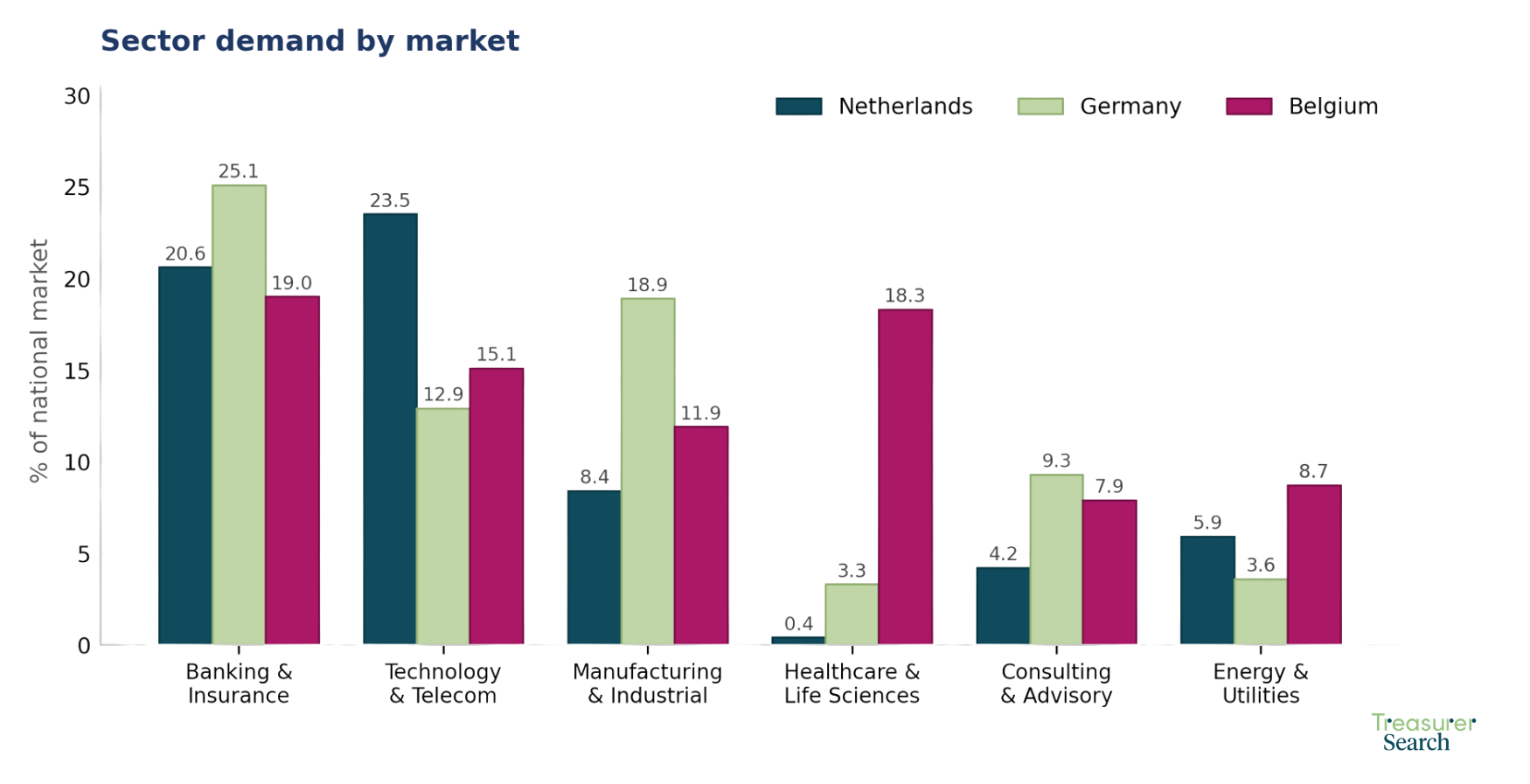
Banking, insurance and asset management remains the largest single sector in Germany at 25.1%, and shares the lead in Belgium at 18.4%. In the Netherlands it has been overtaken. Technology, software and telecom led the Dutch market with 23.5% against banking’s 20.6%, with Booking.com, Adyen and ASML now competing directly with ABN AMRO, ING and Rabobank for the same profiles. That reordering has consequences for pay benchmarks that reach well beyond the technology sector itself.
Manufacturing and industrials accounted for 18.9% of German vacancies, the second largest sector there and roughly double its share in the Netherlands. Siemens, BASF, Salzgitter and the wider Mittelstand run treasury as a standalone function rather than an appendage of group finance.
Belgium’s distinguishing sector is healthcare and life sciences at 18.4%, level with banking. Johnson & Johnson in Beerse, UCB, IBA and Eurofins give the country a life-sciences treasury base with no equivalent concentration in either neighbouring market.
Consulting and advisory tracks the size of the underlying market: 9.3% in Germany, 8% in Belgium and 4.2% in the Netherlands. Where that share is low, treasury transformation work is more likely being resourced internally.
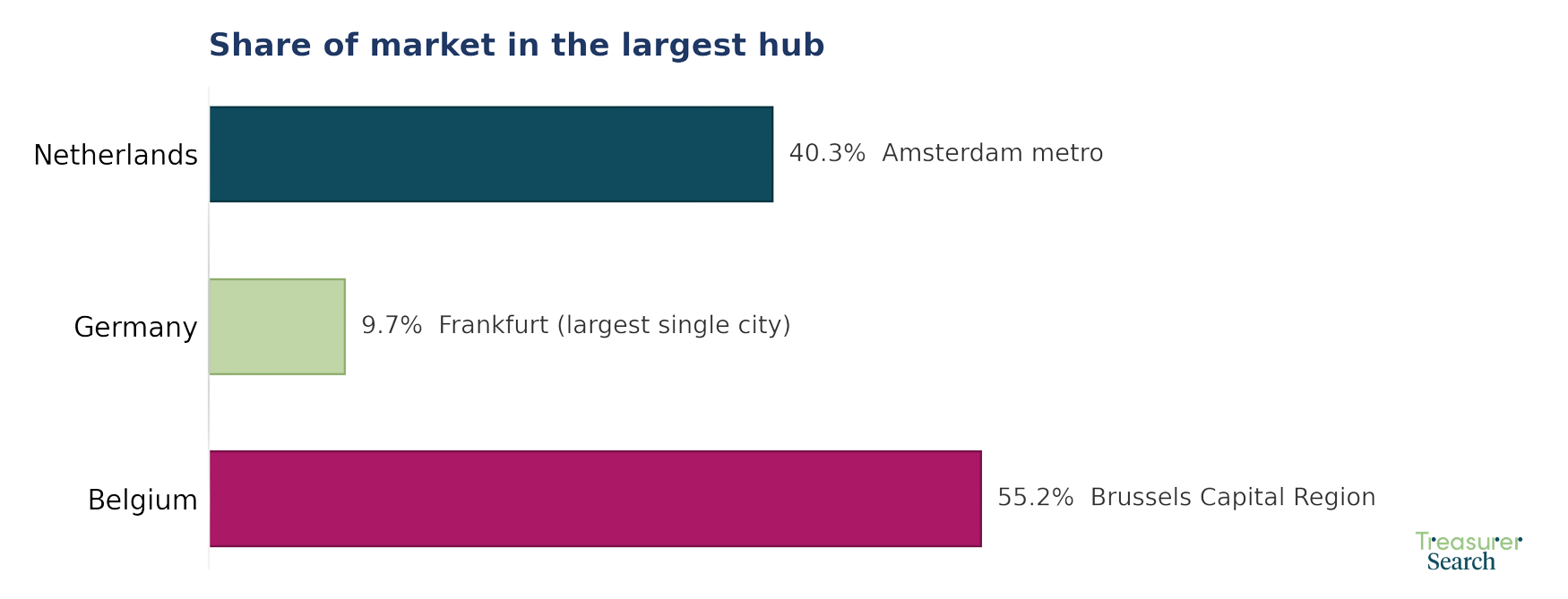
Geographic concentration varies more sharply than any other measure. Belgium is the most centralised market: 55.2% of vacancies sit in the Brussels region including Zaventem, Diegem and Machelen, with Flanders adding 28.8% and Wallonia registering a single vacancy across six months. Treasury in Belgium is a Brussels and Flanders function, and any search built on a different assumption will exhaust its candidate pool quickly.
The Netherlands is concentrated but not closed. The Amsterdam metro area accounted for 40.3%, with Rotterdam and The Hague at 19.3% and Utrecht at 12.6%. Hybrid arrangements out of Amsterdam draw candidates from both without requiring relocation, which effectively widens the pool beyond what the headline figure suggests.
Germany has no dominant hub at all. Frankfurt led on 9.7%, followed by Hamburg at 8.6%, Munich at 8.4%, Duesseldorf at 8% and Berlin at 7.1%. No single city passes 10%, and the top fifteen cities together account for only 55.6% of vacancies, with the balance spread across a further 244 locations. Recruiting in Germany means engaging with several regional markets plus a long industrial tail rather than one national one.
Taken together, the H1 2026 data describes three markets that are converging on the same profile of treasury professional while approaching the supply problem in opposite ways. Germany builds, the Netherlands partly builds and partly buys, and Belgium buys. Where volume is smallest, competition for experienced practitioners is sharpest, because there is no pipeline behind them.
For employers, the practical implications differ by market. In Belgium, the absence of any junior intake means competition for mid-level talent will not ease on its own, and interim mandates are already filling part of the leadership gap. In the Netherlands, salary benchmarks are increasingly set outside financial services. In Germany, the assumption that Frankfurt is the answer is worth testing, since Duesseldorf, Munich and Hamburg often offer deeper local supply and materially less competition.
For professionals, the cross-border picture is encouraging at mid and senior level, where all three markets are active, and considerably harder at the top. Between them, these markets produced approximately 60 Executive and Head of Treasury vacancies in six months. Depth, systems fluency and cross-sector exposure remain the qualities that separate candidates in every one of them.
126 Belgian treasury vacancies analysed. Mid-level takes 59.5%, entry-level hiring has nearly vanished, 55% of roles sit in Brussels.

238 Dutch treasury vacancies analysed. Technology now outhires banking at 23.5%, mid-level roles dominate, and only six Head of Treasury roles reached market.

1014 Treasury-Stellen analysiert. Keine Stadt hält 10% des Marktes, Banken führen mit 25,1%, ein Viertel aller Stellen ist Einstiegsniveau.
Disclaimer about these numbers!
These figures reflect treasury and treasury-adjacent vacancies captured in our own database for 1 January to 30 June 2026, covering 1,377 roles across the three markets. They are an approximation, not an official labour-market statistic. Some postings are duplicated across job boards, some are never advertised publicly, and industry classification is based on the hiring company. We are not the law. But we do know this market, and the shape of the data holds up.
If you want to discuss more on this topic, reach out to our specialists: