Ron van Haeff
Director Interim Services
When discussing the treasury interim market in Europe, three neighbouring countries offer a fascinating contrast: the Netherlands, Germany, and Belgium. Despite their geographic proximity, the maturity, dynamics, and mindset surrounding interim treasury professionals differ significantly.
Understanding these differences is crucial, not only for hiring managers but also for treasury professionals navigating cross-border opportunities.
The Netherlands has firmly established itself as a mature interim market. Interim hiring is not viewed as an exception or a last resort, but as a fully accepted workforce strategy.
Dutch organisations typically prefer to work with one trusted supplier rather than engaging multiple agencies simultaneously. This model is built on partnership and confidence: clients rely on their chosen provider to deliver a curated selection of high-quality profiles.
Rather than creating noise, this approach creates efficiency.
Clients still retain choice, but without duplicated efforts, conflicting communication, or unnecessary market friction.
Another structural factor contributes to the Netherlands’ strong interim culture: lean treasury teams.
Compared to many other European countries, Dutch treasury departments are often relatively small. When a team member becomes unavailable, whether due to resignation, illness, parental leave, or project demands, the operational pressure on remaining colleagues increases rapidly.
In such environments, interim professionals are not a luxury.
They are a pragmatic solution.
Germany presents a different landscape.
Treasury teams are typically larger and more layered. As a result, immediate operational urgency tends to be less acute. Instead of reacting quickly to temporary gaps, German organisations more frequently engage interim professionals for specific projects or specialised initiatives.
These assignments, however, arise less frequently.
Another notable characteristic of the German market is its hiring approach. It is common for organisations to invite multiple agencies to search for candidates simultaneously, effectively sending everyone to “fish in the same pond.”
While this may appear competitive, it creates unintended consequences.
Only one agency will ultimately be compensated for its efforts. The others absorb the cost of unbillable time, research, and candidate engagement. Over time, this dynamic inevitably influences pricing structures. Margins rise. Ironically, the client later questions these higher margins, a familiar debate within many professional communities.
There is also a candidate-side impact. Interim professionals are often approached multiple times for the same assignment, generating confusion and fatigue rather than a positive hiring experience.
Efficiency, once again, becomes the hidden casualty.
Belgium represents yet another stage of market evolution.
The concept of treasury interim professionals is still less deeply embedded. When Belgian organisations consider temporary external expertise, they often turn first to the Big Four consulting firms rather than independent contractors or specialized interim professionals.
This preference has clear implications.
Consulting-driven solutions frequently come with significantly higher cost structures, while the flexibility and agility of independent interim professionals remain underutilized.
This difference is visible in market activity: the pool of active treasury interim professionals in Belgium remains comparatively limited.
Simply put, the ecosystem is still developing.
Beyond structural and cultural factors, language requirements play a decisive role across all three markets.
Belgium strongly favours Belgian nationals or French-speaking professionals.
Germany typically requires fluency in German alongside English.
The Netherlands stands out for its flexibility: in many cases, English proficiency alone is sufficient.
This openness significantly broadens the available talent pool and reinforces the Netherlands’ position as the most dynamic treasury interim market in the region.
When combining market maturity, hiring dynamics, and accessibility, a natural ranking emerges:
The Netherlands: the most mature and fluid interim treasury market
Germany: structured, selective, and project-oriented
Belgium: still evolving and consultant-driven
For organisations, recognising these differences enables smarter workforce strategies. Interim hiring is not merely about filling gaps, it is about choosing the right model for operational continuity, expertise deployment, and cost efficiency.
For treasury professionals, market awareness shapes career decisions. Language capabilities, mobility, and expectations must align with local market realities.
One lesson stands out across all borders:
The interim market is not just about availability.
It is about mindset.
And in that respect, the Netherlands continues to set the pace.

How to use AI to structure and refine your interview preparation while keeping your answers authentic, personal, and credible.

A concise comparison of the treasury interim markets in the Netherlands, Germany, and Belgium, highlighting differences in maturity, structure, and mindset.

Ein Überblick über den deutschen Treasury-Arbeitsmarkt 2025, basierend auf 517 Vakanzen.
How to Recruit Gen X, Millennials, and Gen Z, Without Losing Your Mind (or Your Wi-Fi Connection)
Workforces today are more generationally mixed than ever. You may be interviewing a Gen X’er who printed the job posting to read it carefully… and five minutes later, a Gen Z’er who Googled your company while you were still introducing yourself.
Recruiting these generations requires nuance, empathy, and, let’s be honest, slightly different communication skills.
This guide breaks down Gen X, Millennials, and Gen Z in a sharp, humorous, practical way, so you can tailor your recruitment strategy to each group.
| FACTOR | GEN X | MILLENNIALS | GEN Z |
| Values | Security, autonomy, expertise | Purpose, development, balance | Impact, authenticity, inclusivity |
| Tone | Direct, practical, concise | Warm, meaningful, transparent | Honest, short, human, visual |
| Channels | LinkedIn, email, phone | LinkedIn, email, webinars | LinkedIn, Instagram, YouTube,, TikTok |
| Recruiter Strategy | Show facts, stability, KPIs | Show mission, growth path | Show impact, culture, real stories |
| Work Style | Independent, efficient, no drama | Collaborative, ambitious, flexible | Fast, creative, values-driven |
| Development Needs | Certifications, mastery | Coaching, leadership growth | Learning sprints, mentorship |
| Retention Drivers | Stability, autonomy, respect | Advancement, balance, belonging | Purpose, flexibility, inclusion |


✔ Do
❌ Don’t
Gen X:
“Tell me the facts, show me the plan, and don’t waste my time.”
Millennials:
“Show me the purpose, support my growth, respect my balance.”
Gen Z:
“Be real, give me impact, and don’t pretend to be something you’re not.”
Recruiting across generations isn’t difficult, it’s about respecting their history, understanding their drivers, and adjusting your approach. Do that well, and you’ll build a workforce that blends experience, innovation, and the best of all worlds.
How to use AI to structure and refine your interview preparation while keeping your answers authentic, personal, and credible.
A concise comparison of the treasury interim markets in the Netherlands, Germany, and Belgium, highlighting differences in maturity, structure, and mindset.
Ein Überblick über den deutschen Treasury-Arbeitsmarkt 2025, basierend auf 517 Vakanzen.
Or: how to hire the generation that grew up swiping before they could walk.
Gen Z (born roughly 1997–2012) is the first generation that doesn’t remember a world without smartphones, social media, and streaming everything instantly. They have grown up in a world of constant updates, endless options, and, frankly, a lot of noise.
If you are trying to recruit them with boilerplate job posts, hashtags, or “fun office perks,” good luck. They see right through it.
Gen Z is smart, fast, socially conscious, and slightly impatient.
They are the generation that can TikTok a 60-second hack for folding laundry while finishing a Zoom lecture and scrolling Instagram, all without breaking a sweat.
Key traits:
1. Channels: fast and digital
Instagram, TikTok, YouTube, LinkedIn. Short, engaging, visual content that shows your company in action. But don’t just post memes, they can smell inauthenticity.
2. Tone: authentic, inclusive, purpose-driven
Skip the hype and buzzwords. Show impact: “This is how you can make a difference in 3 months.” Highlight your values, but only if they’re real.
3. Proof: tangible and social
Reviews from current employees, stories, examples. Projects with real impact, measurable outcomes. Social proof matters: Gen Z checks Glassdoor, TikTok, and Instagram before believing anything.
They want to know why their work matters, not just what it is. Projects that change processes, help people, or save the planet → big points.
Remote work, flexible hours, hybrid schedules. Trust them to manage their own time, micromanagement kills motivation.
Mentoring, workshops, online courses, quick learning loops. They want to grow fast, learn new skills, and move horizontally as well as vertically.
Inclusion isn’t optional; it’s a baseline. Transparent communication, collaboration, and feedback loops matter.
Hybrid work → essential.
Salary → fair, transparent, and tied to results.
ESG/CSR → not optional; they research it before applying.
Management style → supportive, approachable, coaching, not commanding.
Benefits that matter → mental health support, learning budgets, flexible time off, clear career pathways.
They want impact. They want flexibility. They want authenticity.
Get those three right, and you will attract a generation that can learn fast, innovate, and bring fresh energy, just make sure your values are real, or they will swipe left.
How to use AI to structure and refine your interview preparation while keeping your answers authentic, personal, and credible.
A concise comparison of the treasury interim markets in the Netherlands, Germany, and Belgium, highlighting differences in maturity, structure, and mindset.
Ein Überblick über den deutschen Treasury-Arbeitsmarkt 2025, basierend auf 517 Vakanzen.
A client approached us right before the Christmas holidays with an urgent request: extra hands on deck in their treasury team. Timing is everything in recruitment, and December is not always the easiest month to kick off a new search.
However, by aligning on the profile quickly and mapping out the entire recruitment process upfront, we were able to schedule interview slots for early January before everyone logged off for the holidays. That thorough process management made all the difference. No delays, no unnecessary back-and-forth, just a clear timeline and strong momentum from day one.
The result? A very smooth process with a fantastic shortlist of treasury professionals. In fact, the quality of the candidates combined with the team’s growth needs led to an unexpected but great outcome: instead of hiring one candidate, our client decided to hire two.
In just 1,5 months, two treasury professionals successfully placed.
This case once again shows how important structure, speed and clear communication are in niche recruitment. Especially in treasury, where the right expertise is scarce and demand can shift quickly, a well-managed process can turn urgency into opportunity.
Are you planning to expand your treasury team in 2026? Let’s discuss how we can help you move quickly, without compromising on quality.

How to use AI to structure and refine your interview preparation while keeping your answers authentic, personal, and credible.
A concise comparison of the treasury interim markets in the Netherlands, Germany, and Belgium, highlighting differences in maturity, structure, and mindset.
Ein Überblick über den deutschen Treasury-Arbeitsmarkt 2025, basierend auf 517 Vakanzen.
Or: how to attract the generation that survived flip phones and now dominates Zoom calls.
Millennials (born roughly 1981–1996) are the generation that bridges analog childhoods and digital adulthoods. They watched dial-up turn into high-speed internet and survived Y2K panic twice if you count their student loans.
They crave purpose, development, and a sense of achievement, but they’re also pragmatic: rent, mortgages, and side hustles await.
Millennials are adaptable, socially conscious, and tech-savvy, but not hyperconnected like Gen Z.
Key traits:
Familiar Millennial Scenes
• The professional who sets Google Calendar alerts for “self-care time” while juggling team meetings. The employee who asks: “Can we measure the ROI on this CSR initiative?” before approving a budget. The remote worker with a standing desk and a side hustle selling hand-poured candles on Etsy.
1. Channels: professional + social
LinkedIn, email, Slack, webinars. Mix serious content with glimpses of your company culture.
2. Tone: meaningful, transparent, slightly casual
Avoid hype. Speak plainly about career paths, development, and company mission. Show real-life impact: “Here’s how your work matters this quarter.”
3. Proof: tangible results & culture
Success stories, employee experiences, metrics. Clear paths for development and mentorship.
Purpose & growth
Opportunities for skill-building, leadership, and professional recognition. Projects with measurable outcomes and visible impact.
Flexibility
Hybrid work, flexible schedules, and remote options. Balance matters, they won’t sacrifice life for work.
Development & mentorship
Learning programs, stretch assignments, and coaching. Millennials thrive when they can grow and help others grow too.
Culture & belonging
Inclusive, collaborative, and communicative environments. Recognition and feedback are key.
They want growth. They want balance. They want purpose.
Hit those three, and you’ll attract a generation that is loyal, motivated, and capable of bridging the gap between the experienced Gen X and the fast-moving Gen Z.
How to use AI to structure and refine your interview preparation while keeping your answers authentic, personal, and credible.
A concise comparison of the treasury interim markets in the Netherlands, Germany, and Belgium, highlighting differences in maturity, structure, and mindset.
Ein Überblick über den deutschen Treasury-Arbeitsmarkt 2025, basierend auf 517 Vakanzen.
The Belgian treasury market in 2025 reflects a function that has largely moved beyond basic cash management and into a more strategic, experience-driven role within organisations. Across sectors, companies are looking for treasury professionals who can operate independently, manage complexity, and contribute to financing, risk management, and transformation initiatives.
By looking at seniority levels, industry distribution, and geographic concentration, a clear picture is painted of how treasury roles are positioned in Belgium today, and where demand is structurally strong or limited. The data below highlights not only who is being hired, but also what kind of treasury function organisations are building.
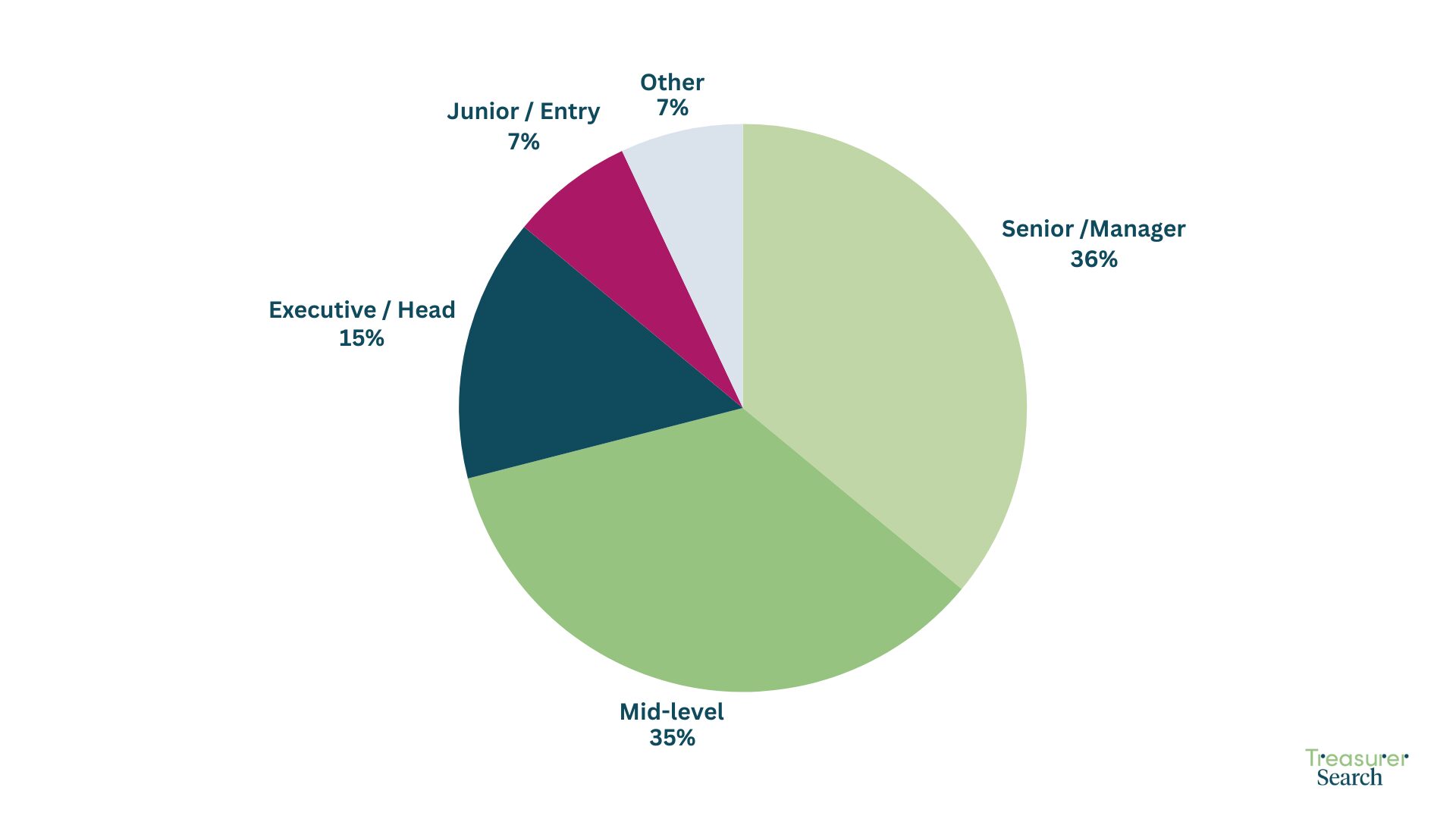
The Belgian treasury market in 2025 was clearly tilted toward experienced profiles. Senior and managerial roles made up 36% of the market, closely followed by mid-level positions at 35%. Together, this means over 70% of treasury hiring targeted professionals with solid hands-on experience rather than entry-level talent.
Executive and Head of Treasury roles accounted for 15%, which is relatively high and points to ongoing leadership turnover, transformation projects, and succession planning. Junior and entry roles remained limited at just 7%, confirming that Belgium continues to be a tough market for early-career treasury profiles.
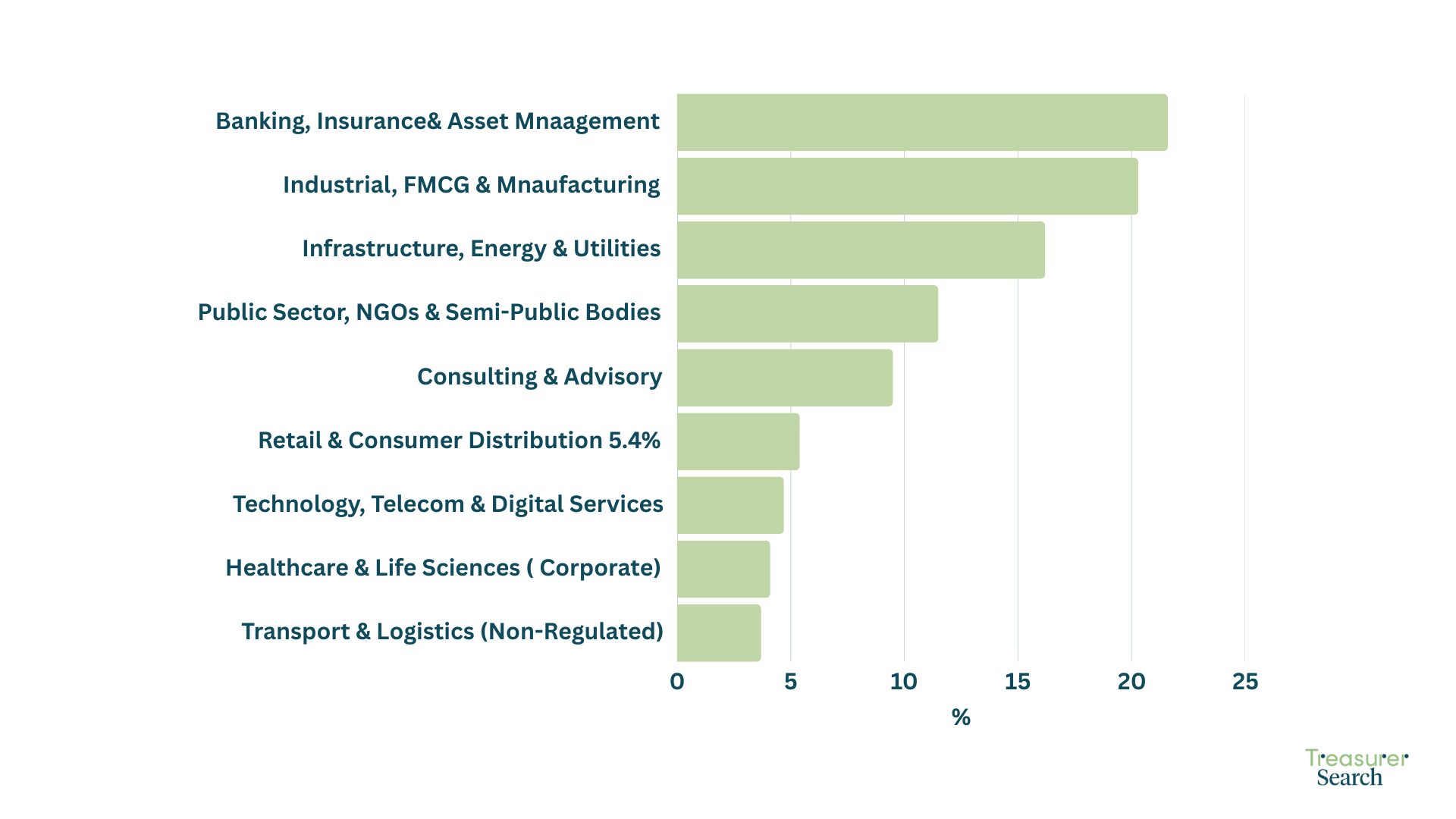
From an industry perspective, demand was well diversified but still higher in traditional sectors. Banking, insurance, and asset management led with 21.6%, narrowly ahead of industrial, FMCG, and manufacturing at 20.3%.
Infrastructure, energy, and utilities followed strongly at 16.2%, reflecting continued investment, financing complexity, and cash management needs in capital-intensive sectors.
The public and semi-public space also played a meaningful role at 11.5%, while consulting and advisory firms represented nearly 10%, underlining sustained demand for treasury transformation and project expertise.
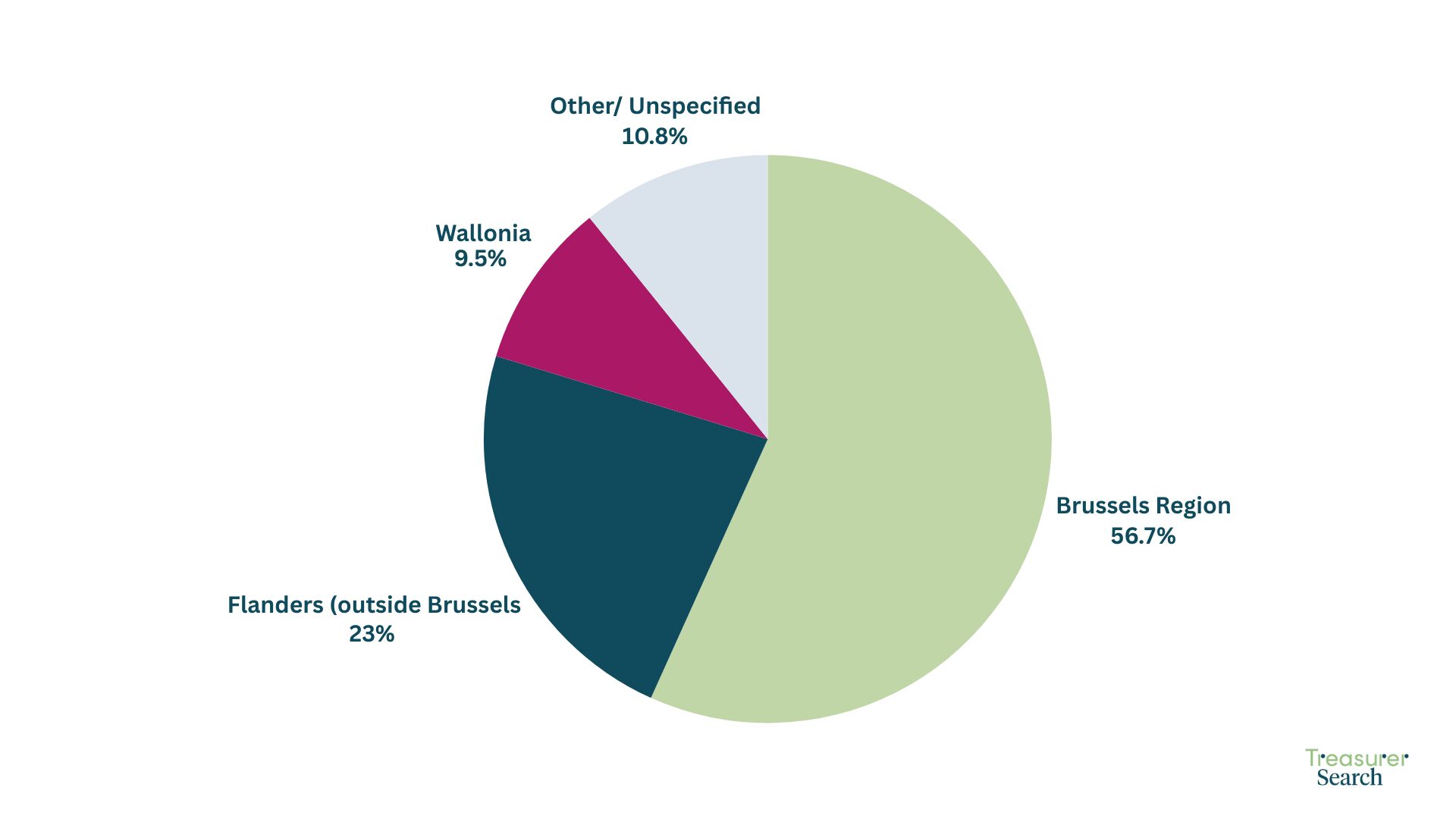
Geographically, the market remained highly centralized. Nearly 57% of roles were based in the Brussels region, including key business hubs such as Zaventem and Diegem. Flanders accounted for 23%, driven mainly by Antwerp and surrounding industrial clusters, while Wallonia represented a smaller share at 9.5%.
The remaining 10.8% reflects roles with a national scope or less specific location data, often linked to hybrid or multi-site setups.
Taken together, the 2025 data paints a picture of a mature and selective treasury market. Demand is concentrated at experienced levels, leadership roles are actively evolving, and junior entry points remain structurally limited. Industry demand is diversified but still rooted in financial services, industry, and infrastructure, while geography continues to favour Brussels as the dominant treasury hub.
For employers, this means competition for experienced treasury talent remains high. For professionals, it reinforces the importance of depth, adaptability, and cross-sector exposure. Belgium in 2025 is not a high-volume hiring market for treasury, but it is a market where expertise, leadership, and strategic capability are clearly valued.
If you want to discuss more on this topic, reach out to our Belgium specialist, Haia Aaraj.

How to use AI to structure and refine your interview preparation while keeping your answers authentic, personal, and credible.
A concise comparison of the treasury interim markets in the Netherlands, Germany, and Belgium, highlighting differences in maturity, structure, and mindset.
Ein Überblick über den deutschen Treasury-Arbeitsmarkt 2025, basierend auf 517 Vakanzen.
After two years of growth our team stabilized at about 11. As from our start in 2009, we record all relevant job openings and potential assignments. This has always been for internal analysis purposes. For the first time we will give you some insight into treasury labour market developments. Team Germany and Belgium will be the first in this, keep an eye on what they publish. What I can say is that we see a gradual growth in all our markets.
We do see a shift in the three most common sources of success in recruitment:
The first source remains important, advertising used to be print or job board oriented, nowadays social media, both for advertising as well as direct approach becomes more prominent. We notice that recruitment colleagues with a generalist approach have it harder than niche players like we are.
In the interim market we read and hear a lot around regulatory and compliance topics. There is a lot of concern but reality is that nothing changed for those companies who need temporary support. Especially Ron had an excellent second half of the year and we do not see that market slowing down.
As to the seniority of the candidates we find a new position for, we see an increase in success at group treasurer level. Personally I think in 2024 a bit too much of my time went into our internal organisation. In 2025 I enjoyed working on assignments at senior level. What is nice this does not go at the expense of junior assignments, we find from second career step up to retirement and are able to mirror this into our team: junior consultants for junior candidates, senior for seniors. And what is not standard in our industry, our consultants stay with the most junior already almost 2 years in the team.
One market plan I am very happy with, how it evolves, is our focus on what we internally call “treasury providers”. When we started, we had a sole focus on corporate treasury. Increasingly our clients asked for candidates with an expertise in consultancy, with TMS providers and from banks. And we were able to deliver. Very organically, these providers started asking us for staff and that client group is growing. We now have two specialized recruiters for this market.
A further nice development, not scheduled, was an increase in DCM and other funding assignments. Next to cash, risk, IT and other sub task fields, we always found funding experts but now the revenue share of this group grew, especially in the German market. Often this career station is the last before rising to group treasurer level and the strategic impact of these job holders can be huge.

As to what you can expect from us, we will not drastically change our ways. We remain niche recruiters, knowing more about corporate treasury than others and in most cases know the candidate before we find his/her next job. Two aspects will be prominent: technology (AI) and events.
I will not try to cover all that will change due to technology in our organization. But you might have noticed that Monique and Bianca both left our team after being with us over 10 years. In both cases, their initiative. In both cases to choose a whole new path in their career: HR and care. We will miss them and wish them well. Monique did a lot of meeting planning. As some of you might already have noticed, we implemented automation, where you can plan directly into our agenda.
This is a new, convenient and efficient way. Bianca worked a lot on updating and coding of files, so consultants can make the best matches. It will not surprise you that AI can make coding partly redundant. We are very happy Yvonne started because Monique and Bianca did so much more and not all can be automated.
In times that LinkedIn, WhatsApp and other channels become more prominent and many live meetings are replaced by video meetings, we notice that real dialogues remain essential in building real relations. This is why we will continue to invest in events. You can expects us at Eurofinance, FinanzSymposium, ATEB, ATEL, DACT and other events. Especially with the people of treasuryXL we have some exciting plans and personally, I will continue to moderate webinars.
Of course I will not and cannot disclose all details of our operations and plans but I want to wrap up with an internal, shared ambition. As confirmed at a recent DACT event, treasurers have a chance to have an increased impact on the strategy and results of their organization. Often their plans are solid, the step to take is claiming a place at the table. This also applies to leadership of teams. Success of treasury relies on quality of team members and how they are managed. This of course implies that the owner of a treasury recruitment process is the hiring manager. Our ambition is to support all hiring manager in reaching next level leadership impact.
On behalf of Team Treasurer Search, looking forward to making 2026 a success with you.
Pieter

How to use AI to structure and refine your interview preparation while keeping your answers authentic, personal, and credible.
A concise comparison of the treasury interim markets in the Netherlands, Germany, and Belgium, highlighting differences in maturity, structure, and mindset.
Ein Überblick über den deutschen Treasury-Arbeitsmarkt 2025, basierend auf 517 Vakanzen.
Or: how to attract the generation that still remembers fax machines… in 2025.
We often talk about Gen Z as if they are the only generation that exists (“They want what? Two sabbaticals a year?!”). But before the TikTok generation took the stage, there was a generation quietly keeping the world running: Generation X.
Born between 1965 and 1980, raised without the internet but with cassette tapes, and brought up with the classic motto: “Act normal, that’s crazy enough.” No drama. No hype. Just deliver.
And that is exactly why you need to approach them very differently in recruitment.
Gen X is the generation that started in an analog world, witnessed the digital revolution, and adapted without complaint. They can work with Outlook, Teams, Slack, and, if absolutely necessary, even SharePoint.
They survived: oil crises, rounds of reorganizations, performance reviews before the word coach even existed, and kids sharing their Netflix password with half the school.
The result? Pragmatic professionals with a radar for nonsense and a deep sense of responsibility.
Every organization has them:
1. Channels: professional & efficient
No TikTok dances, no glittery Instagram stories. They are not impressed by hashtags. They are impressed by:
2. Tone of voice: straightforward, honest, concrete
Include: what the role really involves, how much autonomy they have, how success is measured, and why it is not just a “role through the revolving door.”
No fluff. No buzzwords.
3. Proof: facts, please
Gen X loves: case studies, KPIs, references, and real examples of impact.
“We are a dynamic organization” says nothing. “We improved our efficiency by 18% last year” says everything.
A good salary matters. A solid pension matters even more. They often have mortgages, families, and sometimes aging parents to care for. In short: security scores high.
Gen X knows how to get work done. Give them a goal, not micromanagement. They micromanage themselves enough already.
This generation values craftsmanship. They want to use their experience to make a real difference. not just tick boxes for KPIs.
No endless soft-skills workshops. Yes to: targeted certifications, serious masterclasses, mentoring younger colleagues.
Hybrid work → Yes, but with clarity. Monday at home? Then really Monday at home.
Salary → Important. Keep it transparent, no nonsense.
ESG/CSR → Fine, as long as it is not just a façade. Their bullshit detector is at level 100.
Loyalty → Handle it right, and they stay for the long haul.
Management style → Direct, respectful, results-oriented.
Communication → Prefer solid updates over flashy teasers.
Benefits that matter → Pension, healthcare, extra leave, bonuses tied to measurable results.
If you want to attract Generation X, remember one thing:
They do not want glitter. They do not want hype. They want to know what the work is, why it matters, and whether you are trustworthy.
Hit that tone right? You will have a generation quietly, unflappably, and with dry humor, delivering even the toughest projects successfully.
How to use AI to structure and refine your interview preparation while keeping your answers authentic, personal, and credible.
A concise comparison of the treasury interim markets in the Netherlands, Germany, and Belgium, highlighting differences in maturity, structure, and mindset.
Ein Überblick über den deutschen Treasury-Arbeitsmarkt 2025, basierend auf 517 Vakanzen.
Our client is in the middle of a major transformation, and we have supported them multiple times with both interim and permanent talent.
This time, they needed a seasoned interim Risk Manager to design new policies for newly emerging financial risks, with a permanent successor to follow.
The high-profile interim role, filled fast.
What we did not plan? The match was so strong that both client and interimmer wanted to continue together permanently.
And who are we to stand in the way of a great match?
We brought both sides together, and with one candidate, we successfully filled both the interim and permanent position.
How to use AI to structure and refine your interview preparation while keeping your answers authentic, personal, and credible.
A concise comparison of the treasury interim markets in the Netherlands, Germany, and Belgium, highlighting differences in maturity, structure, and mindset.
Ein Überblick über den deutschen Treasury-Arbeitsmarkt 2025, basierend auf 517 Vakanzen.
We speak a lot about them, but hardly ever hear a corporate treasurer tell us about how smooth the implementation of the new TMS went. Best reviews were situations where the treasurer knew the solution from before, was a great project leader and willing to do the operational. Perhaps he was just bragging 😉
Most implementations are led by treasury consultancy firms who, on average, do a great job. They have done it before, they have the expertise, have back up colleagues when needed and do not eat too much time out of your already tight budget.
Next to compliments, we also hear corporate treasurers sometimes complain. The consultancy firm might claim too steep a price and are constantly on the look-out which project with you they can pick up next. The consultant who sold the project and did the intake is not the one doing the actual work, information is lost. The very junior consultants are sometimes educated not by their colleagues but by you, the client and corporate treasurer, and your colleagues. And in this tight labour market, also consultancies suffer from fluctuation, resulting in you having new contact persons constantly.
There is another option that might tackle some of these issues: hiring an interim manager. Depending on your requirements, it might be a former consultant now operating under own name. Often cost is lower, many of them are more hands-on and the commitment often feels differently, which for example makes it easier to call again. Downside would be if the interim manager gets sick or is not available for another reason. Continuity is an issue. Also expertise could be too narrow.
It is obvious that this is not a simple equation and it depends on your situation what would work best for you. Time, money, DIY as much as possible are all factors. And sometimes it is as simple that consultants are not available and you have to settle for an interim manager. Or the other way around.
How to use AI to structure and refine your interview preparation while keeping your answers authentic, personal, and credible.
A concise comparison of the treasury interim markets in the Netherlands, Germany, and Belgium, highlighting differences in maturity, structure, and mindset.
Ein Überblick über den deutschen Treasury-Arbeitsmarkt 2025, basierend auf 517 Vakanzen.