
Antonio Avanzini
Recruitment Consultant DACH
We successfully placed a Treasury Risk Manager in Hamburg, after joining a search that was already well underway.
Four other recruitment agencies were already looking for the right person when we became involved. The client had been searching for some time, and several candidates were already in the process. We knew we were joining late, but felt there was still an opportunity to bring in our network.
The role required someone with experience in financial risk management, including FX, interest rates, liquidity and investments. The client also needed someone who could work independently and help build structure in a treasury function that was still developing. We focused on understanding that combination properly. The technical experience mattered, but so did the candidate’s ability to work in an environment where not every process was already in place. We were looking for someone who could contribute from day one and take ownership of their area.
Eight days after we joined the search, we introduced the candidate who was eventually placed. That was a great result, especially considering the head start the other agencies had. The process still took a little longer to complete. Holidays and other candidates already in the process meant that the final decision needed some time. But the client and candidate remained interested, and the placement was successfully finalised.
Joining a search late, with four other agencies already involved, is never the easiest starting point. But a good network can still make a difference.
This placement was a good reminder that the timing of a search does not decide the outcome. Sometimes the right candidate is still out there, and the right introduction is all it takes to move things forward.
Are you looking for a treasury professional who fits both the role and the team? Get in touch.

As recruiters, we are regularly approached by candidates who need help with their career planning. Some people know from an early age exactly what they want to become when they are older

A Treasury Risk Manager was placed in Hamburg eight days after joining a search already handled by four agencies. Discover how the right network made the difference.

Why do treasury professionals stay with Dutch employers? Explore how transparency, autonomy, flexibility and development shape retention in the Netherlands.
After writing about why treasury professionals stay with Belgian companies, I was asked whether a Netherlands version would say anything new.
The honest answer is that it would not give four completely different reasons.
Treasury professionals in both countries care about trust, the quality of their manager, flexibility and development. Those foundations are familiar. The difference is in the questions people ask before they decide whether a new role is worth the change.
A treasury professional wants to believe in the company they work for. That is true in Belgium and the Netherlands.
The Dutch version of that question often sounds like this: do I understand how decisions are made, how pay progresses and where the company is going?
Professionals want a clear view of the arrangement. They look at salary, bonus potential, development opportunities and expectations around office attendance. They also want to know whether management will support the treasury function when the next investment, refinancing or transformation project comes along.
Clarity does not mean every decision will go the employee’s way. It means the reasoning is visible and consistent.
That can be a strong reason to stay. People are often willing to accept a decision they do not fully agree with when they understand how it was reached.
A supportive manager matters everywhere. Treasury teams are small, and the relationship with the manager shapes the daily experience of the job.
In the Netherlands, autonomy may be an especially important part of that relationship. Professionals want to be trusted with their area of responsibility. They want access to decision-makers and the freedom to raise concerns, improve processes and take ownership of projects.
A manager who checks every detail can make a technically interesting role feel narrow. A manager who gives people room can make a demanding role feel worthwhile.
That room needs boundaries. Treasury professionals still need priorities, feedback and support when a decision carries risk. Autonomy works when expectations are clear and the manager remains available.
Hybrid work is no longer a line in a vacancy text. People want to know how it affects their week.
How long is the commute? Which meetings need to happen in person? Can the team work together without treating home-working days as a sign of lower commitment?
These questions matter because changing employer can mean changing a person’s entire routine. A candidate may be interested in the role, the salary and the company, then decide the move asks too much of their time.
The employers that retain people make the working model understandable. They explain why the team meets in person, give managers consistent guidance and judge performance by the work rather than by office visibility alone.
That is a retention decision, not just a workplace policy.
A new title is one way to grow, but not the only one.
Treasury professionals can develop by owning a TMS implementation, improving cash forecasting, leading a refinancing or gaining more exposure to FX, funding and financial risk. They can build experience with automation, analytics and international operations.
Those opportunities matter because treasury is changing. Organisations need professionals who can understand the numbers, improve the process and explain the implications to people outside treasury.
Someone may stay in the same role for several years if the scope keeps expanding and the work remains interesting. The title may not change quickly. The contribution can.
That only works when the employee receives ownership, visibility and recognition. More tasks are not the same as more development.
The comparison does not need a dramatic conclusion. There is no need to force a cultural difference where the evidence points to common ground.
The same four foundations appear in both markets: trust in the company, a good relationship with the manager, a working model that fits daily life and the chance to keep developing.
The emphasis can differ. In the Netherlands, transparency, autonomy and respect for people’s time may deserve more attention. In Belgium, the full employment package, including benefits, salary structures and regional context, may play a larger part in the conversation.
For employers, the practical question is not which country has the better retention formula. It is what the individual employee needs to keep choosing the role.
Salary still matters. So does the title. But an experienced treasury professional is also deciding whether the move will give them a better working relationship, a clearer future, more influence or a working week that fits their life.
That is why retention starts before someone resigns. It is built through the everyday experience of the role.

As recruiters, we are regularly approached by candidates who need help with their career planning. Some people know from an early age exactly what they want to become when they are older
A Treasury Risk Manager was placed in Hamburg eight days after joining a search already handled by four agencies. Discover how the right network made the difference.
Why do treasury professionals stay with Dutch employers? Explore how transparency, autonomy, flexibility and development shape retention in the Netherlands.
A refinancing does not start when the loan reaches its maturity date.
By then, the lender has already formed an opinion about the business. The quality of the forecasts, the covenant reporting, the communication and the company’s cash position have all shaped that opinion.
For many PE-backed companies, the refinancing conversation is moving closer. European market reports point to growing attention on debt raised in 2021 and 2022, when financing structures often assumed lower interest costs and stronger exit conditions. Refinancing activity already represents a large share of European lending, with borrowers seeking to extend maturities and prepare for a more selective credit market.
The problem starts when a company treats the maturity date as the first deadline.
A lender does not only want to know whether the company can repay or refinance the debt. The lender wants to understand how the business generates cash, how much room exists under the covenants and how management responds when the forecast changes.
That requires reliable information.
The treasury team should be able to explain:
If these answers take weeks to produce, the refinancing process has already started from a weak position.
A refinancing is often presented as a financing project. It is also a test of financial control.
Lenders want evidence that the management team understands its cash flows. Sponsors want confidence that the company can fund its plan. The CFO needs to present a clear and consistent picture to both groups.
Treasury sits at the centre of that process. It connects the bank accounts, the forecast, the debt structure and the daily decisions that affect liquidity. It also identifies problems before they appear in a monthly management report.
This work becomes harder when the business has grown through acquisitions, operates across several countries or relies on manual reporting. A portfolio company can have strong commercial performance and still struggle to explain where its cash will be in six weeks.
A sensible refinancing plan starts at least 12 months before maturity. It begins with a review of the existing facilities and the quality of the available data. It tests the forecast against lower sales, delayed collections, higher interest costs or an acquisition that closes later than planned.
It also gives the company time to fix weaknesses. Bank account data can be consolidated. Reporting can be standardised. Covenant calculations can be documented. The company can approach lenders with facts rather than urgent explanations.
A permanent treasurer may be the right answer for an established group. A refinancing project may call for an interim treasurer with direct experience of lender processes, covenant reporting and debt negotiations.
The best refinancing discussions start before the company needs new money.
Treasurer Search places interim and permanent treasury professionals in PE-backed companies across the Netherlands, Belgium, Germany and Luxembourg. If the debt maturity is on the calendar, the treasury work should already be underway.

As recruiters, we are regularly approached by candidates who need help with their career planning. Some people know from an early age exactly what they want to become when they are older
A Treasury Risk Manager was placed in Hamburg eight days after joining a search already handled by four agencies. Discover how the right network made the difference.
Why do treasury professionals stay with Dutch employers? Explore how transparency, autonomy, flexibility and development shape retention in the Netherlands.
The deal team has reviewed the market, the management team, the customer base and the numbers.
The investment case looks strong. But there is one simple question that most of the time comes too late: What happens to treasury after closing?
Commercial, financial and legal due diligence receive more attention than treasury due diligence. Yet it can expose risks that affect liquidity, debt capacity and the first months of ownership. Recent European private equity research identifies the predictability of cash flows as one of the main obstacles to debt financing. That should put treasury higher on the transaction agenda.
A target may report healthy EBITDA and still create problems for its new owner. Cash may sit in the wrong entities. Local bank accounts may have unclear signatories. The business may depend on a single overdraft facility or one informal banking relationship. FX exposure may exist without a written policy. Intercompany loans may have grown over time without clear terms or repayment plans.
The data room may contain bank statements, debt schedules and financial reports. That does not always provide a working picture of how cash moves through the business every day.
A proper treasury review should answer questions such as:
These questions do not slow down a transaction, but rather reduce the number of surprises after it closes.
In many transactions, finance assumes that treasury belongs to the CFO. The CFO assumes that the local finance teams know the detail. The deal team assumes that the issue can be resolved during integration.
That gap will create risks in the long run.
After closing, the CFO may need to manage a new reporting structure, lender communication, integration decisions and the sponsor relationship. Asking the CFO to reconstruct bank relationships, design a cash forecast and set up an FX framework at the same time is not exactly the best use of that person’s time.
The strongest buyers decide before signing who will own treasury on Day 1. They identify the information that must transfer from the seller, document the banking structure and assess whether the existing team has the capacity and experience to manage the new group.
Sometimes the answer is a permanent hire. Sometimes it is an interim treasurer who starts before closing, supports the transition and builds the foundation for the next phase.
The point is simple: treasury should be part of the investment plan, not an item added to the post-closing checklist.
At Treasurer Search, we work with PE firms and portfolio companies across the Netherlands, Belgium, Germany and Luxembourg. We help them find the treasury expertise they need before a transaction becomes an operational problem.
As recruiters, we are regularly approached by candidates who need help with their career planning. Some people know from an early age exactly what they want to become when they are older
A Treasury Risk Manager was placed in Hamburg eight days after joining a search already handled by four agencies. Discover how the right network made the difference.
Why do treasury professionals stay with Dutch employers? Explore how transparency, autonomy, flexibility and development shape retention in the Netherlands.
When I approach treasury professionals in Belgium about a new role, the answer is not always driven by salary or job title. Many decide to stay because their current employer still gives them good reasons to do so.
That deserves more attention. Recruitment conversations often focus on why people leave: a difficult manager, limited progression, a long commute or a better offer elsewhere. But employers can learn just as much by looking at the people who are approached and decide that moving would not improve their situation.
From my conversations with treasury professionals in Belgium, four reasons come up regularly: confidence in the company, the working environment and relationship with the manager, flexibility, and the opportunity to grow and have an impact.
Stability is often misunderstood as a preference for safety. For many treasury professionals, it is more specific. They have confidence in the company they work for, they understand its direction, trust its leadership and believe the business is in a sound position.
The function has close contact with liquidity, funding, banking relationships and financial risk. Treasury professionals often have a clearer view of a company’s financial position than many other employees. When they believe in the business and its plans, leaving for an unfamiliar organisation can feel like giving up something valuable.
A new role may offer a higher salary, but candidates also ask questions about the company behind it. How stable is the business? How seriously does management take treasury? Will planned investments go ahead? Is the role supported, or was it created to solve a problem without enough resources?
Employers retain people when they give clear answers through their actions. A credible strategy, sensible investment decisions and open communication give employees reasons to stay.
The relationship with the manager carries a lot of weight. Treasury teams are often small, which makes the quality of day-to-day working relationships hard to ignore. One difficult relationship can affect the whole role. A good one can make an external opportunity much less attractive.
Professionals tend to value managers who give them room to do their job, involve them in decisions and remain available when support is needed. They also notice whether credit is shared and whether mistakes can be discussed without blame.
The wider working environment matters too. People build knowledge of the business and relationships with colleagues in finance, tax, accounting, legal and operations. Those relationships make the work easier and often more interesting. Starting elsewhere means rebuilding that internal network.
This is one reason retention cannot sit with HR alone. The experience of working for a company is influenced heavily by the direct manager and the team around them.
Flexibility has become part of how any professional assess an opportunity. They look beyond the number of home-working days in a vacancy text. They want to know how the arrangement works in the team.
Can people plan office days around meetings that benefit from being face to face? Is flexibility treated as normal, or does using it come with an unspoken penalty? How much commuting time will the role add each week?
These questions are practical. A job can be attractive in content and salary, yet still be a poor move if it makes daily life harder. An employer that offers workable flexibility has a strong retention advantage, especially when the employee already knows and trusts the arrangement.
Consistency matters here. Employees are more likely to value flexibility when expectations are clear and managers apply them fairly.
Belgium has a limited number of senior treasury roles. According to our recent report, in the first half of 2026, only 28% were senior roles and 7% Executive/VP roles. That does not mean treasury professionals can only develop by waiting for the next Head of Treasury or Group Treasurer vacancy.
The employers that retain good people find ways to expand the role itself. Someone may take ownership of a TMS implementation, lead a refinancing workstream, improve cash forecasting or gain more exposure to senior management. A treasury professional can also grow by taking responsibility for a new region, mentoring a colleague or becoming more involved in policy and decision-making.
This kind of development is especially relevant in smaller teams, where formal promotion steps may be limited. An employee may keep the same title while their judgement, influence and range of responsibilities increase considerably.
For employers, this requires active attention. Extra work alone is not development. The employee needs ownership, visibility and a clear sense that their contribution is recognised. Managers should discuss what growth means to the individual rather than assuming that everyone wants the same career path.
Salary still matters.It can prompt someone to listen to an approach and can make an offer difficult to refuse. But it is not often the only factor considered by experienced treasury professionals.
A person who trusts the company, works well with their manager, has useful flexibility and can keep developing already has a strong reason to stay. A new employer must offer enough improvement to justify giving up all four.
For Belgian treasury teams, retention starts well before an employee resigns. It is built through everyday management, credible company decisions and conversations about how someone’s role can develop. In a market with limited senior positions, giving people more influence may be more meaningful than giving them a new title.
As recruiters, we are regularly approached by candidates who need help with their career planning. Some people know from an early age exactly what they want to become when they are older
A Treasury Risk Manager was placed in Hamburg eight days after joining a search already handled by four agencies. Discover how the right network made the difference.
Why do treasury professionals stay with Dutch employers? Explore how transparency, autonomy, flexibility and development shape retention in the Netherlands.
Late to the party, but still in time to find the perfect match.
August is often seen as a difficult month for recruitment. People are away enjoying their well-deserved holidays, decision-making slows down, and calendars can be hard to coordinate. This placement was a good reminder that the right network and one focused day can change that.
A client contacted us about an urgent interim treasurer need after first trying to find the right person through another agency. That is why we were late to the party, but our interim network gave us a strong starting point. With the largest interim treasurer pool in the Benelux and DACH region, we were able to move quickly and identify the right match for this assignment.
Within the first couple of hours, we spoke with the right candidates, checked the details of the assignment and we were able to present the right candidate that turned out to be the perfect match for the client’s needs.
The placement was completed within a single day, which is often the standard for our interim assignments.
This is what a strong interim pool makes possible. Even during the summer holidays, the right professional can be found when the network is active, the brief is clear and the search receives focused attention.
One day. One candidate presented. One successful interim placement.
Can I help you too in finding a perfect match? Get in touch.
As recruiters, we are regularly approached by candidates who need help with their career planning. Some people know from an early age exactly what they want to become when they are older
A Treasury Risk Manager was placed in Hamburg eight days after joining a search already handled by four agencies. Discover how the right network made the difference.
Why do treasury professionals stay with Dutch employers? Explore how transparency, autonomy, flexibility and development shape retention in the Netherlands.
Since the start of Treasurer Search in 2009, we keep track of the markets we are active in. Originally fully manual, gradually automating further. It will not come as a surprise we nowadays include AI in these processes. In this article we want to share what analysis of the treasury labour market shows. In gathering data we of course aim at full coverage but do know that is not feasible. At executive level, for example, recruitment processes often are not visiible to us. At entry level, we see in various countries that people enter the labour market in different ways.
Treasury hiring across the Netherlands, Germany and Belgium in the first half of 2026 produced aproximatelly 1,300 vacancies in our database. Read together rather than separately, those three markets tell a story that no single country report can: the same function, recruited in three structurally different ways.
Germany hires across the full depth of the ladder and builds capability internally. The Netherlands hires for technical execution and has been reshaped by employers who were not competing for treasury talent a decade ago. Belgium hires almost exclusively for experience and has effectively stopped developing its own.
Looking at volume, seniority, sector demand and geographic concentration reveals where each market is strong, where it is stretched, and what that means for anyone hiring or moving across borders.
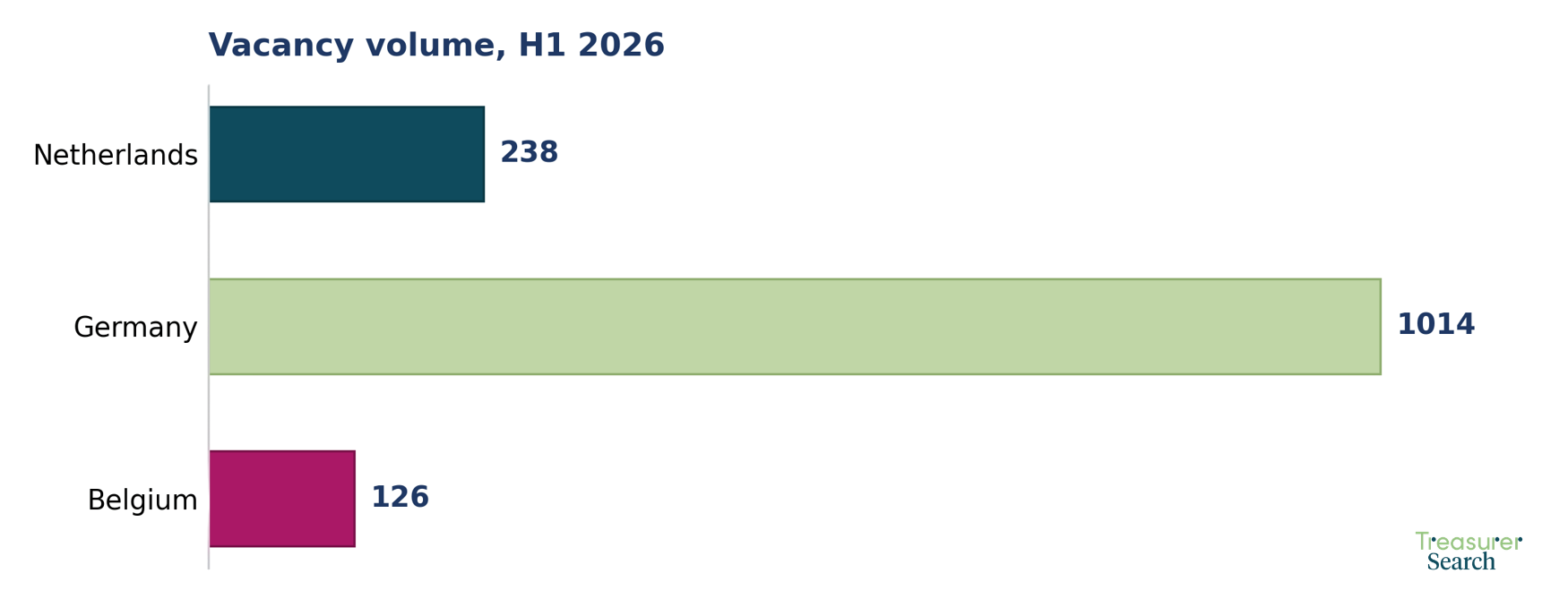
Germany produced 1,014 vacancies against 238 in the Netherlands and 126 in Belgium. Much of that reflects the relative size of each economy. What the sector split adds is that manufacturing accounts for 18.9% of German vacancies against 8.4% in the Netherlands, pointing to an industrial base that carries treasury headcount of its own.
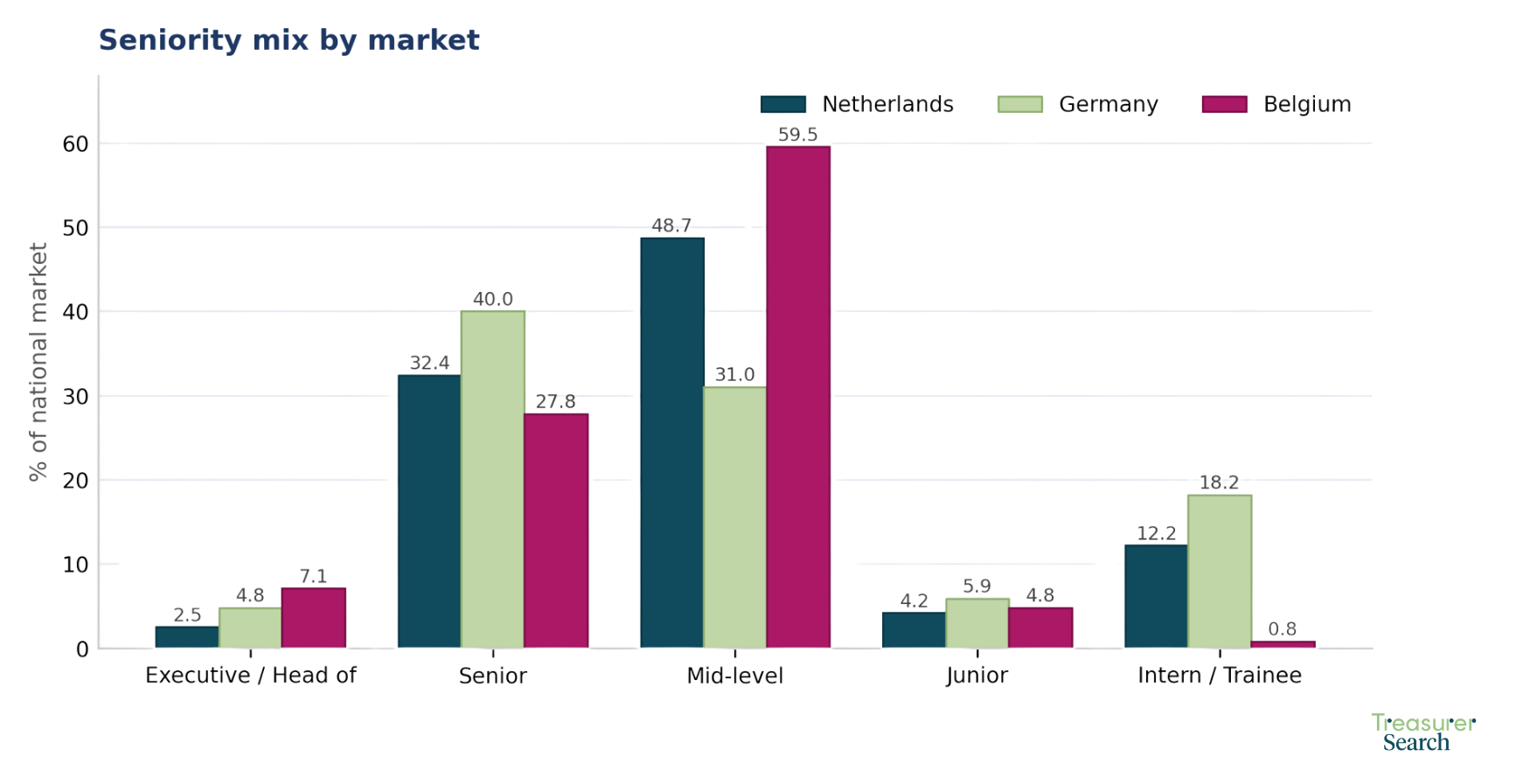
The clearest divergence is at the bottom of the ladder. Germany placed 18.2% of its vacancies in internships and traineeships, with a further 5.9% in junior roles, meaning close to a quarter of all German treasury hiring sits at entry level. The Netherlands recorded 12.2% in internships and 4.2% junior. Belgium recorded a single treasury internship across the six months and six junior vacancies, together under 6% of its market.
That difference is institutional rather than cyclical. The Werkstudent, Praktikum and Ausbildung system gives German employers a structured route to build treasury capability internally. Dutch employers use internships to similar effect, though at lower volume. Belgian employers do neither at any scale, and are consequently buying almost every treasury professional they need from a pool nobody is replenishing.
At the top, the pattern reverses. Executive and Head of Treasury roles accounted for 7.1% of the Belgian market against 4.8% in Germany and 2.5% in the Netherlands. On absolute numbers this reads differently: 49 leadership vacancies in Germany against nine in Belgium and six in the Netherlands. Germany is the only market where treasury leadership search runs at a steady frequency; elsewhere it is an occasional event.
The middle of the ladder is where the comparison gets slippery. Belgium put 59.5% of its vacancies at mid-level against Germany’s 31%, and Germany carried 40% in the senior band against Belgium’s 27.8%. Job titles drive these bands, and German employers apply the Manager label more readily than Belgian ones, so read the gap as indicative rather than exact.
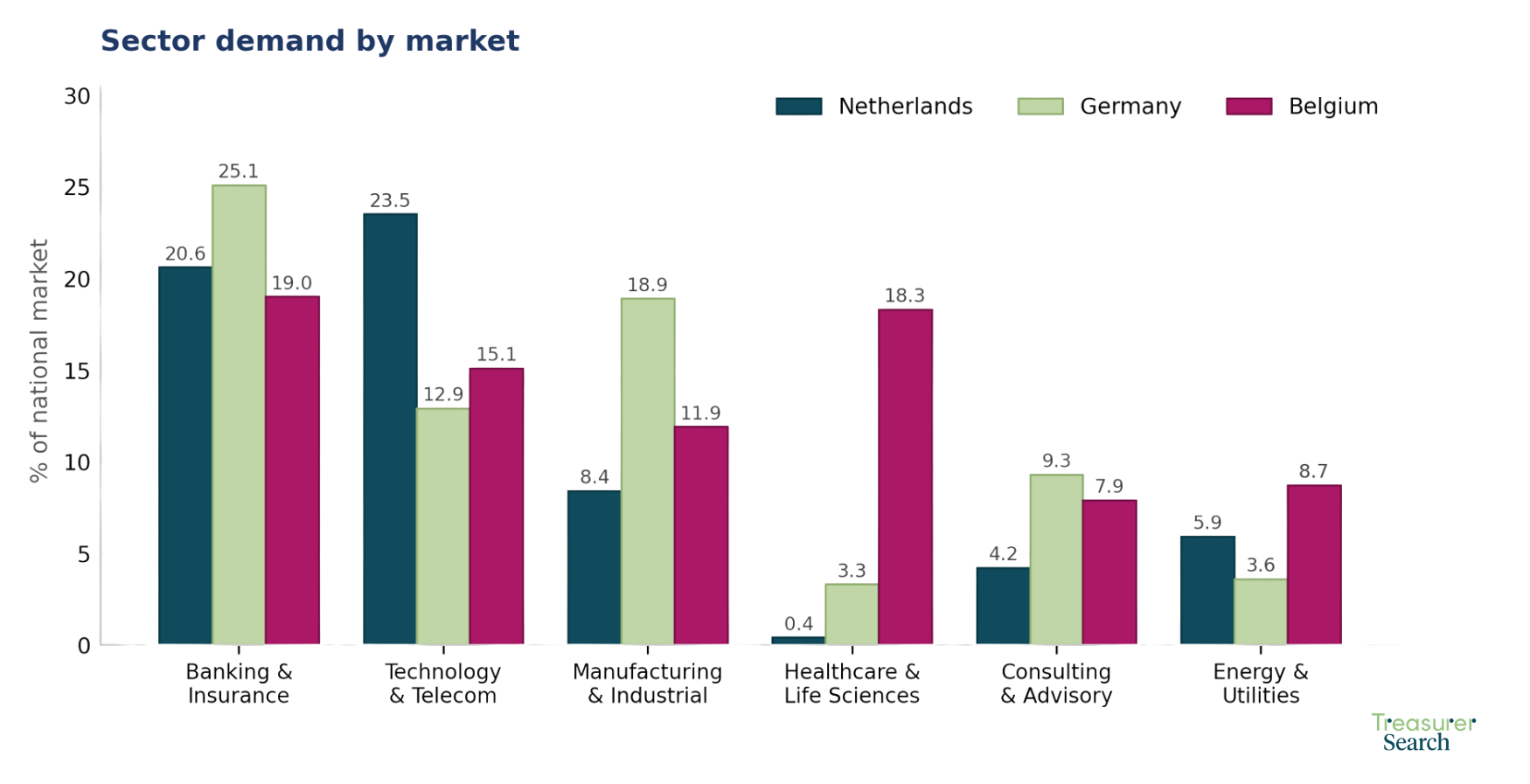
Banking, insurance and asset management remains the largest single sector in Germany at 25.1%, and shares the lead in Belgium at 18.4%. In the Netherlands it has been overtaken. Technology, software and telecom led the Dutch market with 23.5% against banking’s 20.6%, with Booking.com, Adyen and ASML now competing directly with ABN AMRO, ING and Rabobank for the same profiles. That reordering has consequences for pay benchmarks that reach well beyond the technology sector itself.
Manufacturing and industrials accounted for 18.9% of German vacancies, the second largest sector there and roughly double its share in the Netherlands. Siemens, BASF, Salzgitter and the wider Mittelstand run treasury as a standalone function rather than an appendage of group finance.
Belgium’s distinguishing sector is healthcare and life sciences at 18.4%, level with banking. Johnson & Johnson in Beerse, UCB, IBA and Eurofins give the country a life-sciences treasury base with no equivalent concentration in either neighbouring market.
Consulting and advisory tracks the size of the underlying market: 9.3% in Germany, 8% in Belgium and 4.2% in the Netherlands. Where that share is low, treasury transformation work is more likely being resourced internally.
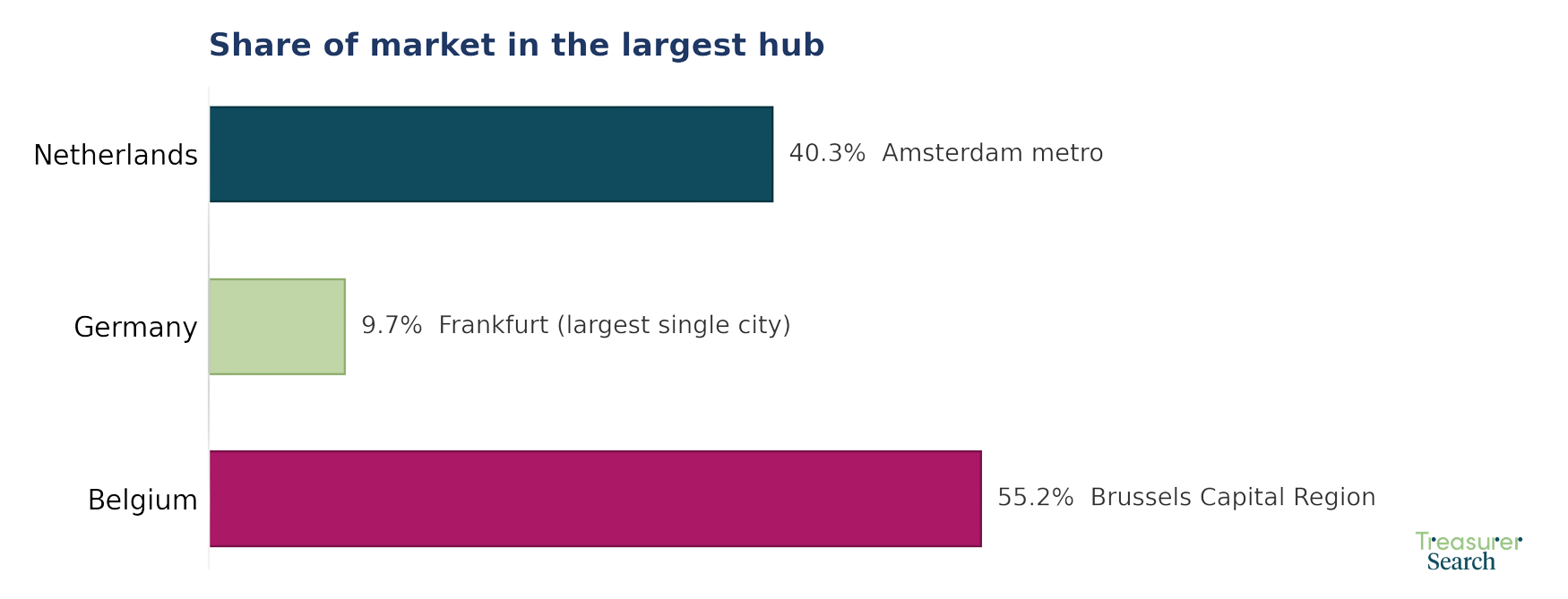
Geographic concentration varies more sharply than any other measure. Belgium is the most centralised market: 55.2% of vacancies sit in the Brussels region including Zaventem, Diegem and Machelen, with Flanders adding 28.8% and Wallonia registering a single vacancy across six months. Treasury in Belgium is a Brussels and Flanders function, and any search built on a different assumption will exhaust its candidate pool quickly.
The Netherlands is concentrated but not closed. The Amsterdam metro area accounted for 40.3%, with Rotterdam and The Hague at 19.3% and Utrecht at 12.6%. Hybrid arrangements out of Amsterdam draw candidates from both without requiring relocation, which effectively widens the pool beyond what the headline figure suggests.
Germany has no dominant hub at all. Frankfurt led on 9.7%, followed by Hamburg at 8.6%, Munich at 8.4%, Duesseldorf at 8% and Berlin at 7.1%. No single city passes 10%, and the top fifteen cities together account for only 55.6% of vacancies, with the balance spread across a further 244 locations. Recruiting in Germany means engaging with several regional markets plus a long industrial tail rather than one national one.
Taken together, the H1 2026 data describes three markets that are converging on the same profile of treasury professional while approaching the supply problem in opposite ways. Germany builds, the Netherlands partly builds and partly buys, and Belgium buys. Where volume is smallest, competition for experienced practitioners is sharpest, because there is no pipeline behind them.
For employers, the practical implications differ by market. In Belgium, the absence of any junior intake means competition for mid-level talent will not ease on its own, and interim mandates are already filling part of the leadership gap. In the Netherlands, salary benchmarks are increasingly set outside financial services. In Germany, the assumption that Frankfurt is the answer is worth testing, since Duesseldorf, Munich and Hamburg often offer deeper local supply and materially less competition.
For professionals, the cross-border picture is encouraging at mid and senior level, where all three markets are active, and considerably harder at the top. Between them, these markets produced approximately 60 Executive and Head of Treasury vacancies in six months. Depth, systems fluency and cross-sector exposure remain the qualities that separate candidates in every one of them.

126 Belgian treasury vacancies analysed. Mid-level takes 59.5%, entry-level hiring has nearly vanished, 55% of roles sit in Brussels.

238 Dutch treasury vacancies analysed. Technology now outhires banking at 23.5%, mid-level roles dominate, and only six Head of Treasury roles reached market.

1014 Treasury-Stellen analysiert. Keine Stadt hält 10% des Marktes, Banken führen mit 25,1%, ein Viertel aller Stellen ist Einstiegsniveau.
Disclaimer about these numbers!
These figures reflect treasury and treasury-adjacent vacancies captured in our own database for 1 January to 30 June 2026, covering 1,377 roles across the three markets. They are an approximation, not an official labour-market statistic. Some postings are duplicated across job boards, some are never advertised publicly, and industry classification is based on the hiring company. We are not the law. But we do know this market, and the shape of the data holds up.
If you want to discuss more on this topic, reach out to our specialists:


After placing treasury professionals in PE-owned businesses for over fifteen years, certain patterns appear with remarkable consistency.
These situations are usually not the result of a lack of intelligence, commitment, or effort on the part of the people involved. In most cases, they are structural in nature and arise because treasury is still approached as an operational support function, while the reality in a PE-owned environment is that it needs to play a far more strategic role.
After the deal closes, attention usually goes first to the most visible integration priorities, and treasury is often addressed too late. That can mean bank accounts are still tied to the seller, Cash visibility is limited to what the CFO can pull from the old ERP. Three months in, the sponsor asks for a group cash report and nobody can produce one.
The fix is straightforward: define who owns treasury before the deal closes, not after.
In many mid-market PE-owned businesses, the CFO is the treasury function. They manage cash, maintain bank relationships, handle FX decisions, and produce covenant reporting, on top of everything else a CFO in a PE-owned business is expected to do.
This is not sustainable, and it creates risk. Treasury decisions made under time pressure, without dedicated expertise, are where expensive mistakes happen.
Ask the CFO of a PE-owned group with five entities whether they have a cash pooling structure. The answer is usually: “It’s something we want to do.” Ask again six months later. Same answer.
In the meantime, cash remains idle across subsidiaries, intercompany positions are not properly structured, and the group continues to absorb unnecessary bank fees and FX costs. Cash pooling may not be the most visible treasury topic, but it often delivers value quickly.
Many PE-owned businesses are exposed to multiple currencies, yet still manage FX without a formal policy. Hedging decisions are then made reactively, often without a consistent framework or clear ownership. This creates avoidable volatility in earnings and makes it harder to explain results when questions arise from sponsors or lenders.
A basic FX framework does not need to be complex, but it does need to exist.
By the time an exit process begins, treasury should already be well organised. Cash flow reporting should be clear, bank relationships properly documented, FX decisions easy to explain, and covenant compliance straightforward to evidence.
In practice, however, treasury often only becomes a real focus in the final months before a sale. That late effort tends to add cost, increase risk, and sometimes expose issues that should have been resolved much earlier.
None of these problems are unusual, and none of them are beyond fixing. With the right expertise in place at the right moment, they can often be resolved faster than expected.
Treasurer Search places interim treasury professionals in PE-owned businesses across the Netherlands, Belgium, Germany and Luxembourg. If any of these situations sound familiar, let’s talk!
As recruiters, we are regularly approached by candidates who need help with their career planning. Some people know from an early age exactly what they want to become when they are older
A Treasury Risk Manager was placed in Hamburg eight days after joining a search already handled by four agencies. Discover how the right network made the difference.
Why do treasury professionals stay with Dutch employers? Explore how transparency, autonomy, flexibility and development shape retention in the Netherlands.
While some recruitment partnerships begin with a single placement, the strongest ones continue to grow over time.
This collaboration began when a candidate we knew recommended us to a client they were working at. One conversation led to a search, and that search led to a placement.
This long-standing client once again asked us to help find a new treasury professional for the team. Over the years, that partnership has grown into eight placements across a wide range of roles, from interim to permanent, from Treasury Specialist to Group Treasurer.
That kind of relationship is built on consistency, trust, and results. By now, we understand not just the job requirements, but also how the organisation works, what kind of professional fits, and what success in the role really looks like. making every new search sharper.
This time, the search was for a Senior Corporate Finance Analyst, a role combining treasury, financing strategy, and financial analysis. The outcome: a strong match on both sides. A candidate with analytical depth and commercial instinct, joining a client that values and invests in its people.
Eight placements is a milestone we are proud of. More than that, it reflects a partnership built on trust and a track record of getting the match right.
Can I help you too in finding a perfect match? Get in touch.
As recruiters, we are regularly approached by candidates who need help with their career planning. Some people know from an early age exactly what they want to become when they are older
A Treasury Risk Manager was placed in Hamburg eight days after joining a search already handled by four agencies. Discover how the right network made the difference.
Why do treasury professionals stay with Dutch employers? Explore how transparency, autonomy, flexibility and development shape retention in the Netherlands.
The Belgian treasury market in the first half of 2026 reflects a function that continues to be built almost entirely through experienced hires. Across sectors, organisations are looking for treasury professionals who can operate independently from day one, and they are showing very little sign of developing that capability internally.
By looking at seniority levels, industry distribution and geographic concentration, a clear picture is painted of how treasury roles are positioned in Belgium today, and where demand is structurally strong or limited. The data below covers 126 vacancies and highlights not only who is hired, but also what kind of treasury function organisations are building.
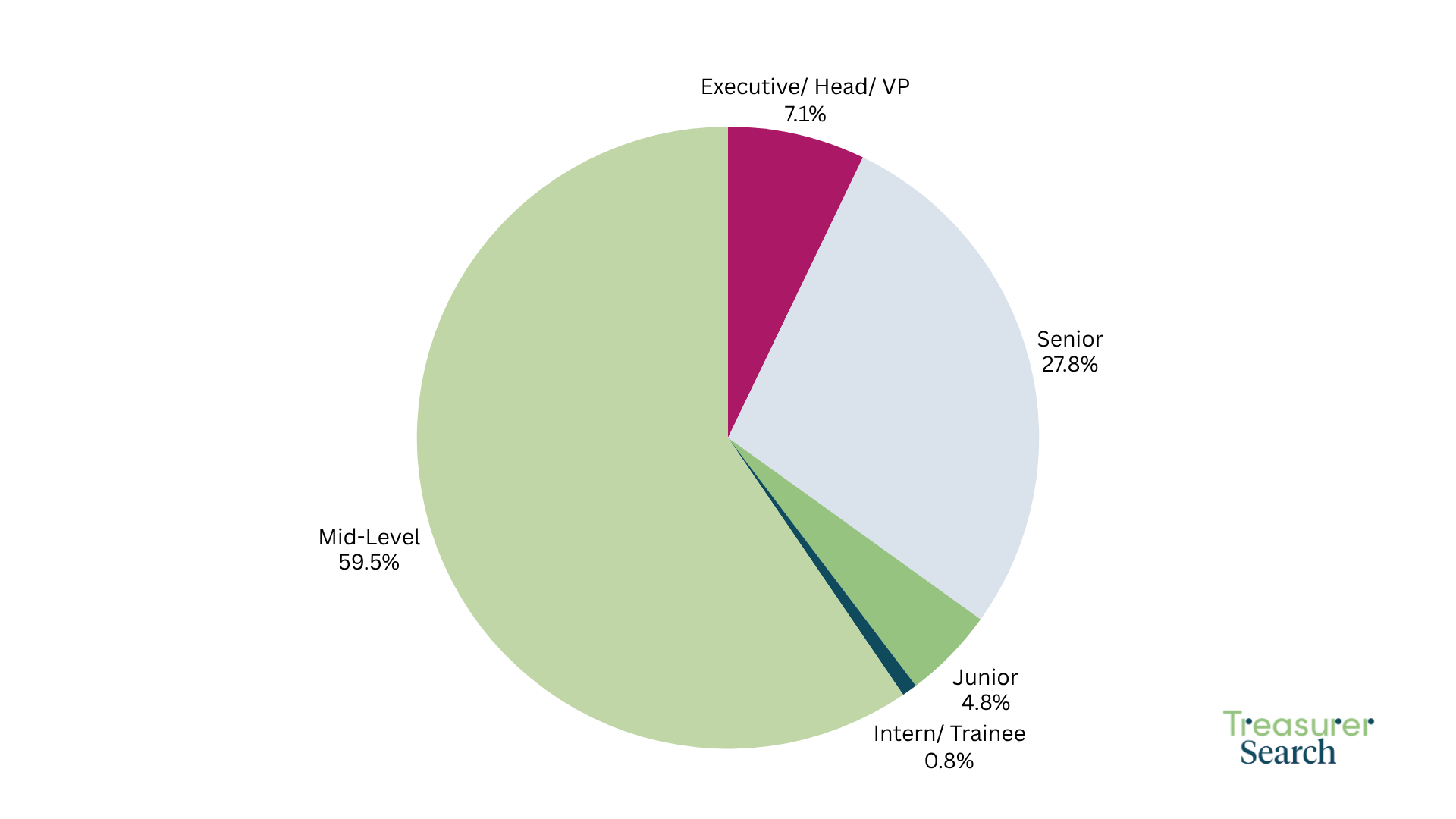
The Belgian market was heavily weighted toward experienced hands-on roles. Mid-level positions made up 59.5% of the market, with senior and managerial roles at 27.8%. Together this accounts for 87% of treasury hiring, leaving very little activity at either end of the ladder.
Executive and Head of Treasury roles accounted for 7.1%, nine vacancies in total, four of which were interim or freelance mandates. This points to turnover within a small leadership pool, with a meaningful share of demand met through flexible arrangements rather than permanent headcount.
Entry-level hiring was close to absent. Junior roles represented 4.8% and internships or traineeships only 0.8%. Belgium continues to be a difficult market for early-career treasury profiles, and the near-total absence of a pipeline tightens the mid-level pool that every employer is already competing in.
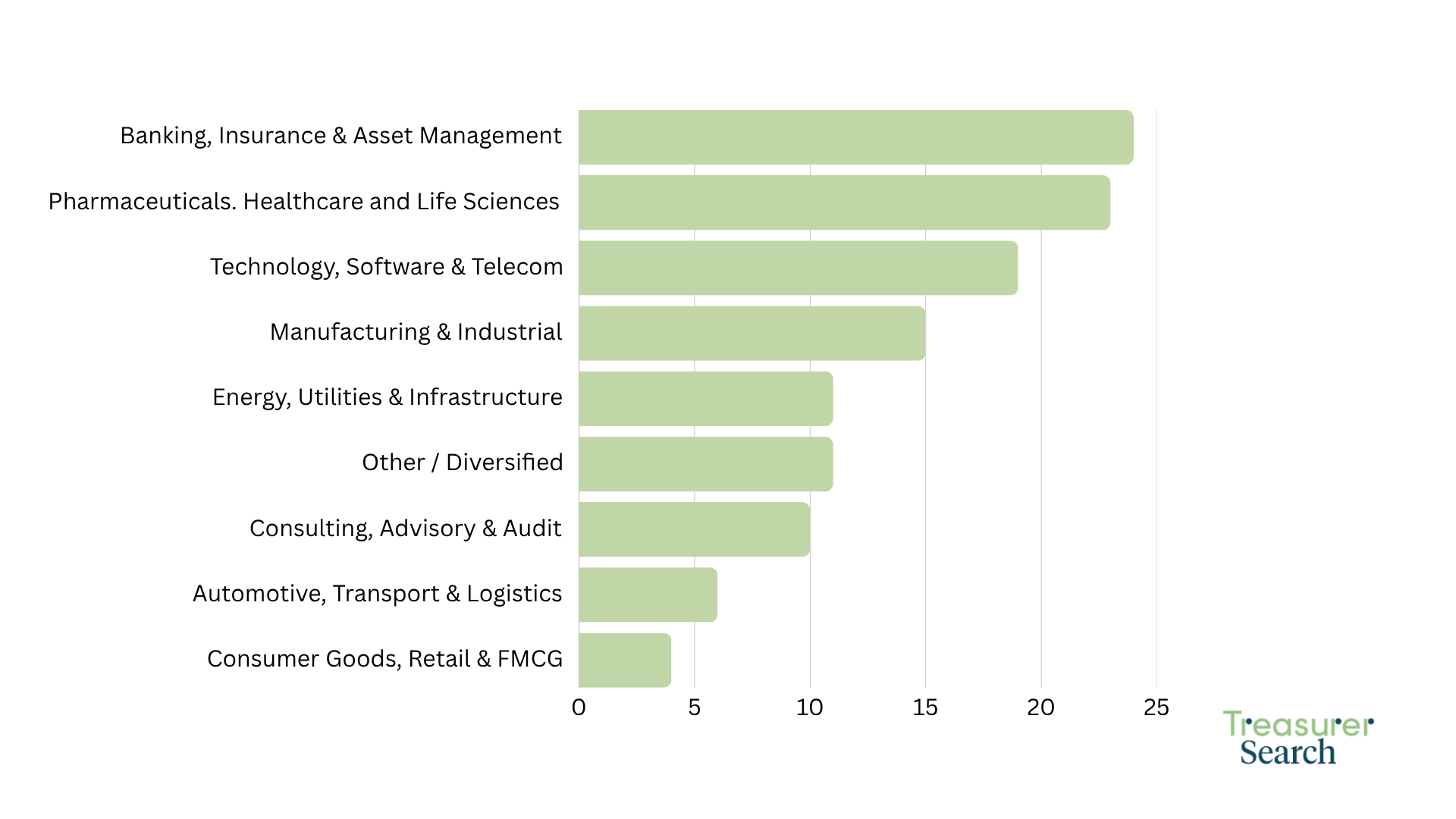
From an industry perspective, demand was well diversified across three sectors of comparable weight. Banking, insurance and asset management led with 19%, narrowly ahead of healthcare and life sciences at 18.3%. That healthcare figure is driven by Johnson & Johnson in Beerse, UCB, IBA and Eurofins, and gives the country an unusually strong life-sciences treasury base.
Technology and telecom followed at 15.1%, ahead of manufacturing and industrials at 11.9%, where Bekaert, Umicore, Atlas Copco and Daikin remain consistently active.
Infrastructure, energy and utilities accounted for 8.7%, including Fluxys and Equans, while consulting and advisory represented 7.9%, underlining sustained demand for treasury transformation and project expertise.

Geographically, the market remained highly centralised. Just under 55% of roles were based in the Brussels region, including key business hubs such as Zaventem, Diegem and Machelen. Flanders accounted for 28.6%, driven mainly by Antwerp, Ghent, Leuven and the Beerse pharmaceutical cluster.
Wallonia registered a single vacancy across the entire six months. Treasury in Belgium is a Brussels and Flanders function, and any search built on a different assumption will exhaust its candidate pool quickly. The remaining 15.9% reflects roles with national scope or less specific location data, often linked to hybrid or multi-site setups.
Taken together, the H1 2026 data paints a picture of a mature and highly selective treasury market. Demand is concentrated at mid-level, leadership roles turn over within a small pool and a significant share arrive as interim mandates, and junior entry points remain structurally limited. Industry demand is diversified across financial services, life sciences and industry, while geography continues to favour Brussels as the dominant treasury hub.
For employers, this means competition for experienced treasury talent remains high, and with almost no early-career intake that competition will not ease on its own. For professionals, it reinforces the importance of depth, adaptability and cross-sector exposure. Belgium in H1 2026 is not a high-volume hiring market for treasury, but it is a market where expertise, leadership and strategic capability are clearly valued.
If you want to discuss more on this topic, reach out to our Belgium specialist: Haia Aaraj.
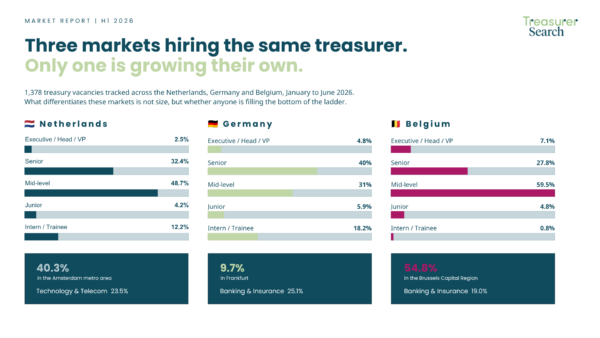
1,378 treasury vacancies across three markets. Germany hires at every level, the Netherlands buys technical depth, and Belgium buys experience.
238 Dutch treasury vacancies analysed. Technology now outhires banking at 23.5%, mid-level roles dominate, and only six Head of Treasury roles reached market.
1014 Treasury-Stellen analysiert. Keine Stadt hält 10% des Marktes, Banken führen mit 25,1%, ein Viertel aller Stellen ist Einstiegsniveau.
These figures reflect treasury and treasury-adjacent vacancies captured in our own database for 1 January to 30 June 2026. They are an approximation, not an official labour-market statistic. Some postings are duplicated across job boards, some are never advertised publicly, and industry classification is based on the hiring company rather than the role itself. We are not the law. But we do know this market, and the shape of the data holds up.